
Freddie Ponton
21st Century Wire
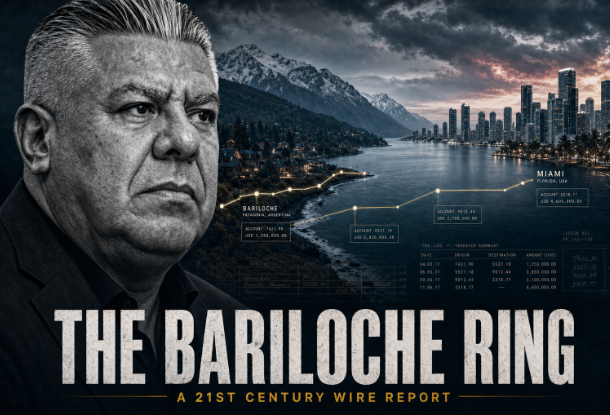
Federal prosecutors in Washington and the Southern District of Florida, working with FBI agents, have opened a preliminary criminal investigation into how the Argentine Football Association handled hundreds of millions of dollars in international revenue. The money trail runs through a Florida-based company appointed to collect AFA’s international commercial revenue, a cluster of Florida shell corporations controlled on paper by private residents of Bariloche, Patagonia, and entities linked to a financial firm already under separate scrutiny in Buenos Aires. The extent of the inquiry became public as Argentina’s World Cup campaign ended.

IMAGE: Claudio “Chiqui” Tapia, president of Argentina’s football federation, stands alongside Lionel Messi. The AFA disputes reports that U.S. agents seized Tapia’s phone or personally summoned him. BA Times)
Argentina lost the World Cup final to Spain on July 19, and Tapia flew home in the middle of the fallout from that loss. On July 22, Infobae reported that FBI agents had approached him and other federation officials at JFK airport and taken their phones before the delegation’s flight, and that Tapia had been summoned to testify before a federal court in Florida on July 30. Clarín confirmed the account hours later, citing its own sources with access to the case. The federation’s lawyer, Gregorio Dalbón, denied both claims by the end of the day, saying it was “absolutely false” that Tapia or treasurer Pablo Toviggino had been personally summoned and that no devices had been seized.
What both sides agree happened is narrower than either version of the story. A federal grand jury in the Southern District of Florida has issued a subpoena to a third party for documents and communications tied to Tapia, Toviggino, and two other men connected to the federation’s finances, Diego Lucero and Javier Faroni. Federal prosecutors and FBI agents from Washington and Miami have already taken testimony from an Argentine businessman named Guillermo Tofoni, who spoke for three hours by videoconference. Tofoni’s civil lawsuit against the federation is what put its banking records in front of American investigators in the first place.
Those records describe a financial structure that Argentine reporters have spent the past seven months tracing back to a single contract, a company called TourProdEnter LLC, and a cast of private citizens whose bank balances bore no relationship to the sums now attached to their names.
The contract
TourProdEnter belongs to Javier Faroni, a theater producer and former legislator for Sergio Massa’s Frente Renovador party, and his wife, Erica Gillette. Under a contract with the federation, the company became the exclusive collector of AFA’s revenue from abroad, according to a copy investigators recovered during raids on the federation’s Viamonte headquarters in December. In exchange, TourProdEnter kept 30 per cent of everything the federation earned outside Argentina, after tax, plus 10 per cent of the funds it moved for logistics.

IMAGE: Javier Faroni, the theatre producer and former provincial legislator linked to TourProdEnter, the Florida company appointed to collect AFA’s international revenues. (Source: Panorama Directo)
The relationship did not end when those transactions came under scrutiny. In October 2025, roughly a year before the agreement was due to expire, AFA quietly renewed TourProdEnter’s mandate through 2030, preserving its 30 percent commission and expanding its authority to administer the federation’s payments abroad. The extension was signed before the December raids that recovered the original contract.
The money passed through five American banks, namely Citibank, Synovus, Bank of America, JPMorgan and PNC Bank. El Tiempo‘s reporting puts the total at at least $260 million, including $60 million from Adidas and $40 million from Warner. A separate complaint filed by the opposition Coalición Cívica estimates the diversion at closer to $300 million.
A large share of that total cannot be matched in the available records to identifiable federation expenses. At least $42 million moved to four Florida companies reported to have no employees or declared commercial activity. Broader reviews of the transactions have placed the amount sent to companies and beneficiaries without a clearly documented economic purpose at approximately $57 million, a figure that appears to include the $42 million rather than represent an additional sum. Other transfers went to SOMA SRL and Cabello SRL, companies tied in reporting to Pablo Toviggino’s family or immediate circle. SOMA received approximately $468,000 in ten transfers between December 2024 and July 2025 and, until May, listed Darío Toviggino, the treasurer’s brother, among its officers. Argentina’s corporate regulator, the Inspección General de Justicia, has separately demanded a full accounting of the federation’s currency flows with TourProdEnter from 2021 through 2025, as well as transfers involving a wider group of companies, including Dicetel Corp and firms belonging to the Sur Finanzas group
Four names in Bariloche
Four of the shell companies receiving TourProdEnter’s money trace back to two couples who live within a few blocks of each other in Bariloche, a city on the eastern edge of Argentina’s Patagonian lake district.
Javier Alejandro Ojeda Jara, a pharmacy employee carrying more than 23 million pesos in documented debt, controls a company called Soagu Services LLC. His partner, Mariela Marisa Schmalz, controls a second company, Marmasch LLC. Bank records show Soagu received $10.8 million and Marmasch received $13.4 million. Both share a mailing address in Miami and the same registered agent in Wyoming.
A short distance away, Roberto Josué Salice and his partner, Verónica Inés López, controlled Velp LLC and Velpasalt LLC, which received $3 million and $14.7 million, respectively. Salice was declared bankrupt by an Argentine court in 2019.
The man who connected the two couples has a name and a public role in the city. Juan Schreiber owns the Hotel Basia and has served as Brazil’s honorary consul in Bariloche since 2015. La Nación identified him as the recruiter of the nominal owners, a finding independently confirmed by LU17 and Nexofin.
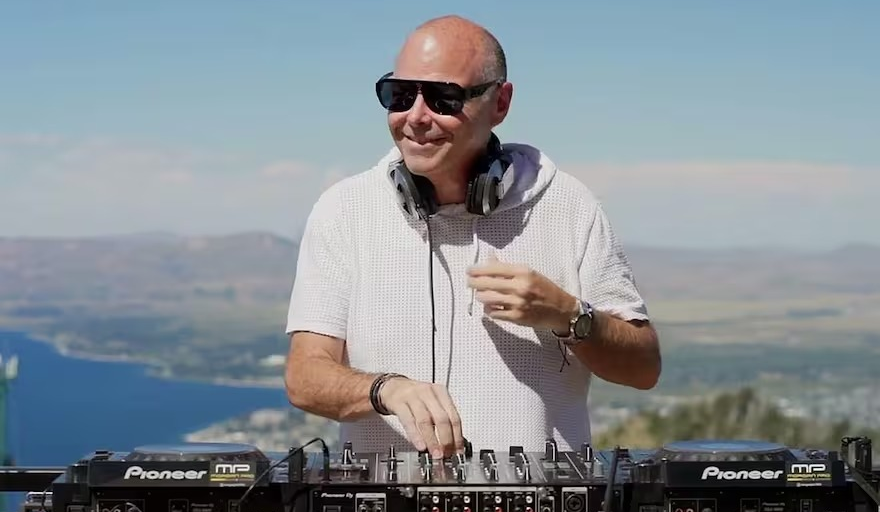
IMAGE: Hotelier Juan Schreiber in Bariloche. Argentine reports have identified the former Brazilian honorary consul as the alleged intermediary who connected local residents to companies receiving TourProdEnter funds. (Source: Diario Río Negro)
No outlet has obtained an independent, on-record statement from Schreiber, Ojeda Jara, Schmalz, Salice or López. What the four were paid for lending their names has not surfaced in any court filing or news account reviewed for this story.
A fifth shell company, W Trading LLC, received $2.3 million before dissolving in September 2024. Its listed owner, Matías Esteban Fernández, was still receiving Argentina’s Universal Child Allowance as recently as 2018.
What the money bought in Florida
Faroni and Gillette used a separate string of Florida entities to convert TourProdEnter’s revenue into real estate they controlled directly, according to The Real Deal. The companies bought an office at Aventura ParkSquare, a condominium at the Acqualina Residences in Sunny Isles Beach, an oceanfront unit nearby, and a smaller residential unit, roughly $11 million in total, all paid in cash. Two weeks before the last of those closings, corporate filings reviewed by the Miami Herald show Gillette’s name was quietly removed from the entity’s paperwork and replaced with her daughter’s.
One case, not two
For most of the past year, coverage of Tapia’s financial troubles has treated two stories as running on separate tracks. First the TourProdEnter’s Florida shell companies, and second, a Buenos Aires financial firm called Sur Finanzas. That distinction no longer holds. The two threads were formally unified in January under federal judge Luis Armella in Lomas de Zamora, after prosecutors traced transfers running through a construction company called Construcciones TAR into Sur Finanzas-linked accounts and onward to at least one football club also under investigation in the TourProdEnter matter.
Sur Finanzas belongs to Ariel Vallejo, a financier whose company sponsors Barracas Central, Tapia’s home club. Vallejo has not denied his relationship with Tapia. “Tengo una relación muy linda, sobre todo con el Chiqui Tapia,” (“I have a very nice relationship, especially with Chiqui Tapia”), he told LMNeuquén. Beyond the sponsorship, Tapia also received a Visa Signature card issued through Banco Coinag and paid for by Sur Finanzas, which the bank has said was the only formal financial link between the two men beyond that friendship.

IMAGE: Sur Finanzas owner Ariel Vallejo, at the lectern, alongside AFA president Claudio “Chiqui” Tapia at a federation event. Vallejo has publicly acknowledged their close relationship. (Source: El Liberal)
In her filing, quoted directly by the Associated Press, prosecutor Cecilia Incardona described the scheme as relying on “the simulation of loans and the transfer of future economic rights,” carried out through “fiduciary vehicles and individuals who present insolvency profiles.” Armella granted her request on December 29, 2025, lifting the tax and banking secrecy of Faroni, Gillette, and everyone connected to TourProdEnter, and ordering the raids that recovered the contract. Faroni and Gillette appeared before him on their own on January 16 to be formally notified of the case. Armella has since ordered a full audit of Club Banfield’s finances and its relationship with Sur Finanzas, including a review of an undeclared cryptocurrency payment tied to the transfer of footballer Giuliano Galoppo to a Brazilian club.
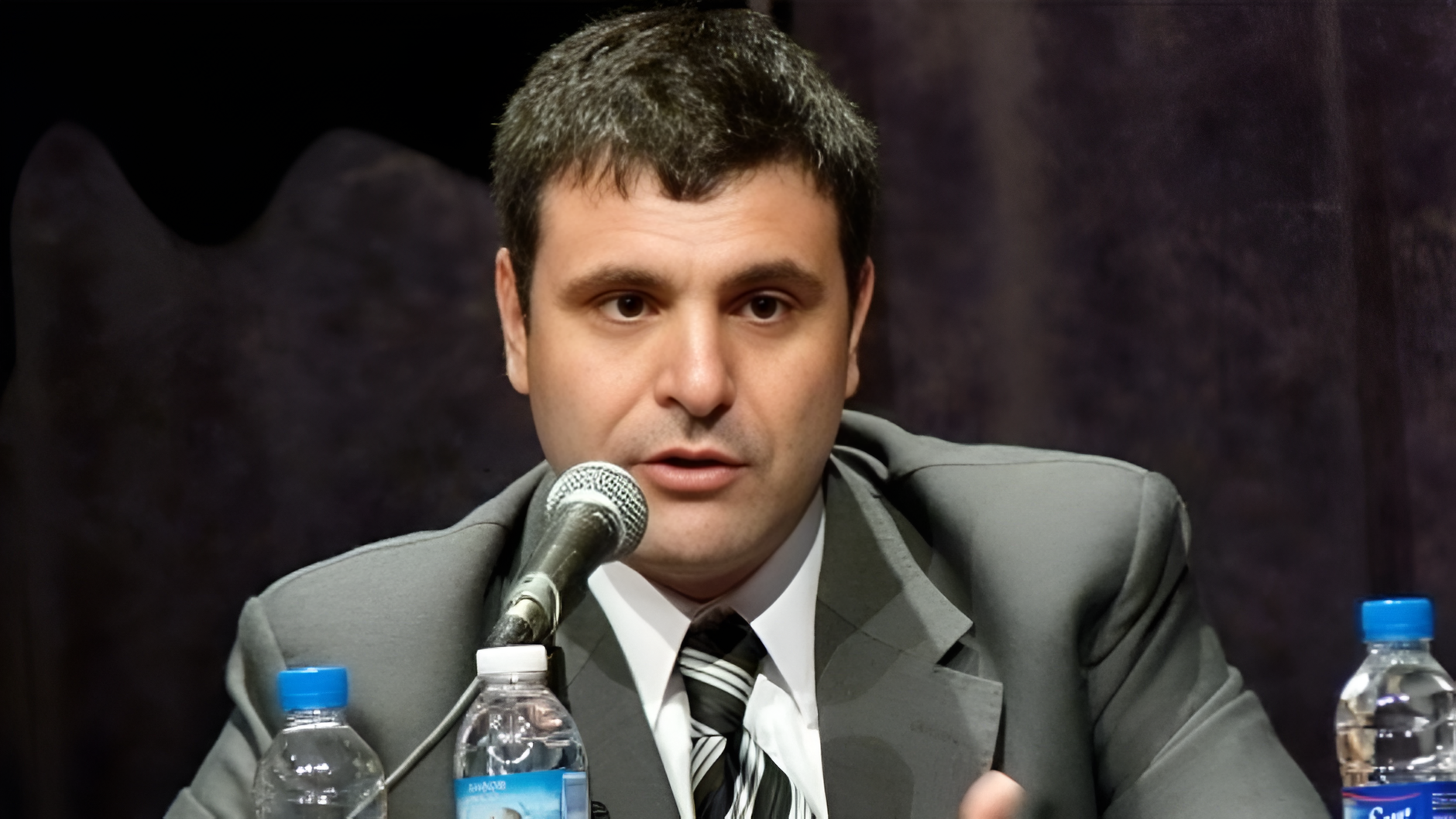
IMAGE: Federal judge Luis Armella, whose Lomas de Zamora court unified investigative threads involving TourProdEnter and Sur Finanzas. (Source: La Política)
The jurisdictional picture since then has been genuinely unsettled. Federal judge Adrián González Charvay in Campana spent much of early 2026 trying to pull the TourProdEnter cases into his own court, arguing they overlapped with his separate investigation into a $17 million mansion in Pilar tied to Toviggino. Campana’s own federal prosecutor objected to that consolidation. By mid-April, an appeals panel referred the underlying competency conflict to Argentina’s Supreme Court, a referral independently confirmed by MDZ Online. The related Pilar case has separately bounced between courts, with the Cassation Court ordering in mid-July that the jurisdictional question be reopened, with a hearing set for August 12, 2026.
Prosecutors have not alleged, and no bank record reviewed for this account shows, a direct transfer of funds between Sur Finanzas’s own accounts and TourProdEnter’s. What connects the two cases is the shared prosecutor, the Construcciones TAR transfers, and a shared cast of names, not a traced wire between the two structures.
The prosecutors and how they got here
The American investigation involves federal prosecutors and FBI agents from both Washington and Miami. Patric Gushue and Christopher Ting are based in Washington; Michael Berger works in the Southern District of Florida. The case reached them through a lawsuit that had nothing to do with laundering. Tofoni, who runs a FIFA-licensed match agency called World Eleven, sued the federation and obtained its banking records through discovery in an American court. Faroni later tried to have Tofoni removed as a civil complainant in the Argentine case, but the attempt failed. In July, Tofoni became the only person close to the case, apart from the federation’s own denials, to speak on the record about it. He confirmed the existence of the confidential investigation, saying that denying it would be “como querer esconder un elefante en una cristalería”, like trying to hide an elephant in a china shop.
Argentine press has taken to calling the case AFAGate, an echo of the 2015 FIFAgate prosecutions, which rested on the theory that payments passing through American banks fall within federal reach regardless of where the underlying conduct took place. That earlier case caught Argentine businessman Alejandro Burzaco, who fled the country before cooperating with prosecutors, and the Jinkis family of Full Play, still negotiating a plea in New York.
The federation’s account
Through Dalbón, the federation disputes the central claims in the July 22 reporting. It has cast the broader wave of accusations as a defamation campaign orchestrated by Tofoni with the backing of Milei’s government, a claim Bullrich’s own CONMEBOL complaint suggests the government does not intend to walk back. It has not disputed the existence of the subpoena issued to the third party, nor the underlying financial reporting from La Nación and the Miami Herald. Tapia and Toviggino have already been formally charged under Argentine procedure in a separate case concerning the alleged withholding of pension contributions calculated at 19 billion pesos ( US$12.7 million). They are also named in a Santiago del Estero prosecutor’s April request to open a formal money-laundering case against 28 individuals. Neither man has been charged in the United States.
A government with its own exposure
President Javier Milei has spent much of the past two years trying to force the federation’s member clubs into a corporate ownership model open to outside investment, a reform Tapia has blocked. That fight sharpened in December when Senator Patricia Bullrich filed a formal complaint against Tapia and Toviggino with CONMEBOL‘s ethics committee, and continued into February when the IGJ demanded a fuller accounting of roughly $450 million in federation balance-sheet entries.
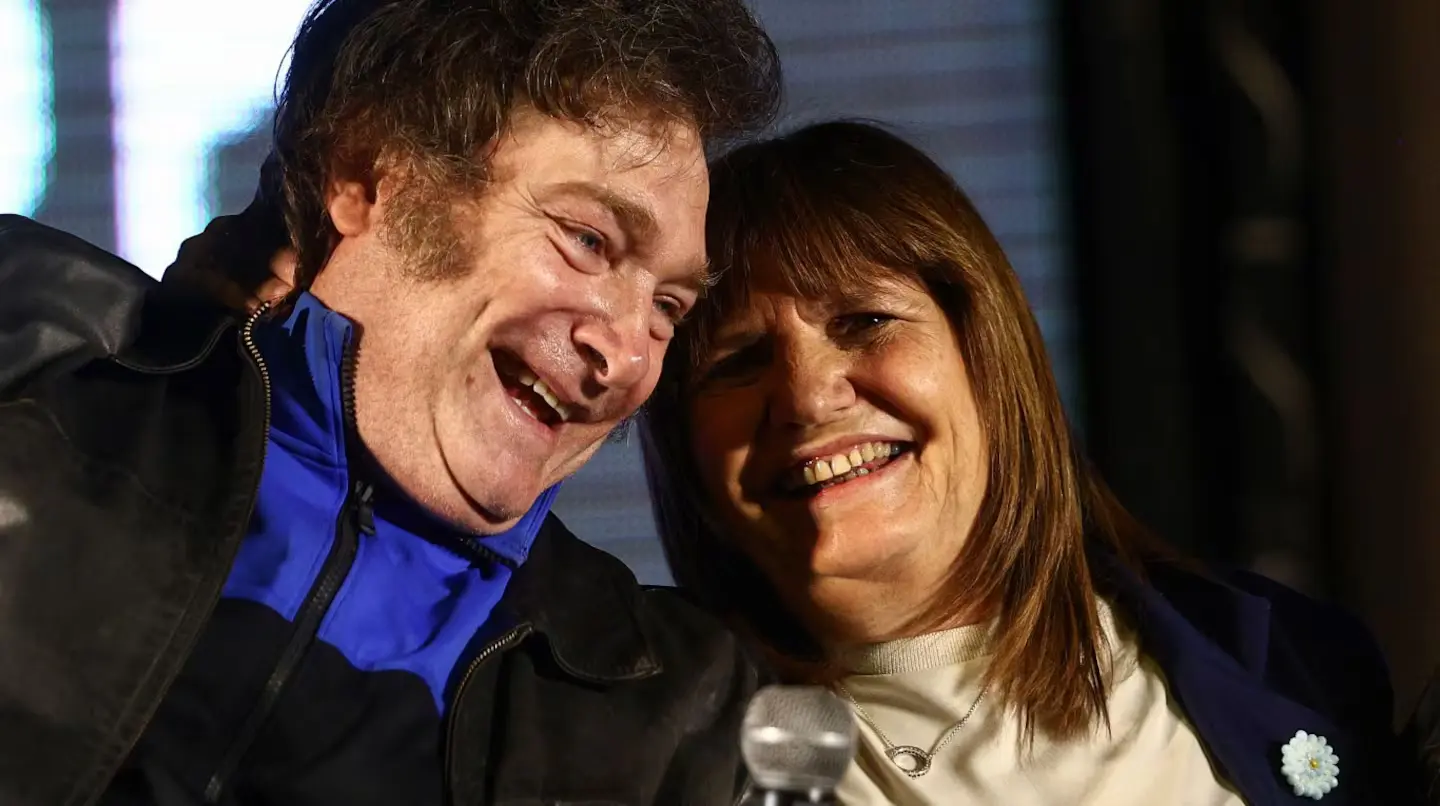
IMAGE: Javier Milei and Patricia Bullrich in 2023, before Bullrich joined his government. As a senator, she later asked CONMEBOL’s ethics committee to investigate AFA president Claudio Tapia and treasurer Pablo Toviggino. (Source: TN Argentina)
Milei’s government is not well positioned to frame that pressure as disinterested oversight. Forensic analysis of a lobbyist’s phone, reported first by La Nación’s Hugo Alconada Mon, showed Milei and his sister, Karina Milei, exchanged repeated calls with the lobbyist, Mauricio Novelli, in the minutes surrounding the launch of the $Libra cryptocurrency, a scheme a congressional committee concluded Milei personally helped promote and that cost investors as much as $400 million. His cabinet chief, Manuel Adorni, resigned in June after acknowledging undeclared assets.
A federation handling several hundred million dollars a year in foreign revenue went unexamined by Argentine regulators for years. The structure now under scrutiny from a federal grand jury, several competing Argentine courts, and a Santiago del Estero prosecutor’s office surfaced only after a civil lawsuit and a discovery order in an American courtroom made it visible.
READ MORE ARGENTINA NEWS AT: 21st CENTURY WIRE Argentina FILES
SUPPORT OUR INDEPENDENT MEDIA PLATFORM – BECOME A MEMBER @21WIRE.TV
VISIT OUR TELEGRAM CHANNEL