

Problem: America’s financial strength has become increasingly dependent on foreign creditors routinely propping-up the US dollar by purchasing risky Treasury securities. Japan may not be able to keep this Ponzi scheme going.
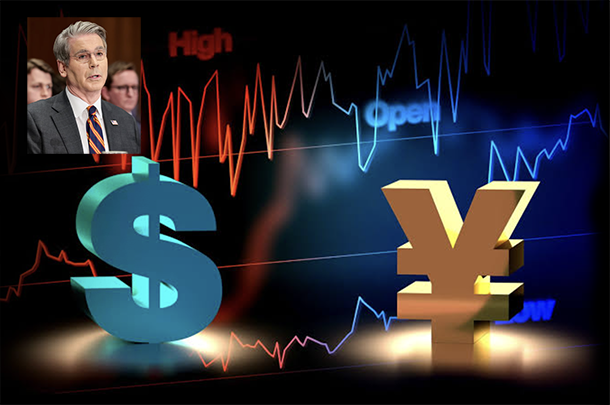
M.A. Hossain writes for Asia Times…
For decades, the global financial system has been founded on a convenient assumption. The US would keep taking on more debt, and countries like Japan would cover the bill.
America got to borrow money at low interest rates, while Japan got to amass massive cash reserves invested in US Treasury bonds. And in the meantime, Japan became an export-driven nation as low interest rates fueled growth among its many multinational companies.
After decades of mutual gains, that bargain is beginning to crack. The recent dramatic depreciation of the Japanese yen is often portrayed as a Japanese domestic problem. But behind the weakening yen lies a structural imbalance that could shake global financial markets, exposing vulnerabilities not only in Tokyo but also in Washington.
Ironically, what begins as a currency crisis in Asia could become a debt crisis in the United States. The greater danger is not merely a falling yen; it is the possibility that one of America’s largest creditors may no longer be willing — or able — to finance America’s expanding fiscal excess.
Falling yen is a symptom, not the disease
The Japanese yen, once regarded as one of the world’s safest currencies, has fallen to its weakest level against the US dollar in nearly four decades, now hovering around 160 per dollar. The reasons are well understood.
The Bank of Japan long maintained low interest rates while the US Federal Reserve aggressively raised them to curb price increases. The result was a huge interest-rate gap between Japan and the US and other Western countries.
As a result, investors were highly interested in a so-called yen-carry trade, i.e. they were borrowing in yen at low interest rates and investing the funds raised in dollar-denominated assets with higher interest rates.
This trade became a powerful source of liquidity for global markets. But it also created relentless selling pressure on the yen. Japan’s dependence on imported energy has further aggravated the situation.
Higher oil and liquefied natural gas prices spiked amid the Iran war and the Hormuz blockade, forcing Japanese importers to exchange increasing amounts of yen for dollars, adding further downward pressure on the currency.
Foreign investment in Japanese equities paradoxically reinforced the trend because many international investors hedged their currency exposure by selling the yen.
These forces have combined to push the currency toward levels unseen since the mid-1980s. Yet exchange rates rarely tell the whole story. They often reveal deeper structural weaknesses beneath the surface.
America’s debt addiction meets Japan’s financial dilemma
Japan remains the largest foreign holder of US Treasury securities. For decades, these investments helped finance America’s expanding budget deficits while keeping Treasury markets stable. That relationship is now under unprecedented strain.
Whenever Japanese authorities intervene to support the yen, they must purchase yen using foreign currencies, primarily US dollars. Those dollars largely come from Japan’s enormous foreign reserves, much of which are invested in US Treasury bonds. Significant intervention, therefore, risks substantial Treasury sales.
Reports already suggest that Japan reduced its foreign securities holdings by tens of billions of dollars in recent months, fueling speculation that reserve drawdowns have begun. Ordinarily, financial markets could absorb moderate Treasury sales. But today’s circumstances are anything but ordinary.
Washington is issuing enormous volumes of new debt while simultaneously refinancing trillions of dollars in existing obligations. Federal deficits continue expanding despite historically high interest rates.
According to the Congressional Budget Office, US publicly held debt already exceeds 100% of GDP and is projected to climb steadily over the coming decades.
If Japan transforms from a reliable buyer into a persistent seller of Treasuries, bond markets could face a volatile adjustment. Higher Treasury yields would ripple throughout the American economy. Mortgage rates would remain elevated.
Corporate borrowing would become more expensive. Commercial real estate—already under pressure—could deteriorate further. Most importantly, the federal government’s own interest payments would continue consuming an ever-larger share of national expenditure.
Empire built on borrowing
The US often presents itself as the indispensable anchor of global finance. The dollar’s reserve-currency status has indeed provided extraordinary advantages. Yet reserve-currency privilege is not a substitute for fiscal discipline.
For decades, Washington has assumed that global demand for dollar-denominated assets would remain virtually limitless. That confidence encouraged persistent deficit spending regardless of which political party occupied the White House.
Republicans cut taxes without proportional spending reductions. Democrats expanded public expenditure through increasingly ambitious fiscal programs. The result has been bipartisan debt accumulation on a historic scale.
America’s financial strength has become increasingly dependent on foreign creditors’ continued purchases of Treasury securities. This is where Japan’s current predicament becomes America’s problem…
Continue this story at Asia Times
READ MORE FINANCIAL NEWS AT: 21st Century Wire Financial Files
SUPPORT OUR INDEPENDENT MEDIA PLATFORM – BECOME A MEMBER @21WIRE.TV
VISIT OUR TELEGRAM CHANNEL