

Freddie Ponton
21st Century Wire
In December 2025, Alpha Elsec shipped 122 armed five-kilogram warhead assemblies from India to Israel. Their customs description and specifications matched the warhead carried by Elbit Systems’ SkyStriker, a loitering munition whose remains had already been documented on the Open Source Munitions Portal after strikes in Khan Younis, in Gaza. The cargo left India almost two years after the International Court of Justice (ICJ) ordered Israel to take provisional measures under the Genocide Convention, including taking all measures within its power to prevent acts covered by Article II. A United Nations commission had since concluded that Israel was committing genocide in Gaza, and a subsequent UN Special Rapporteur’s report listed India among the states that had repeatedly sent arms-and-ammunition consignments to Israel. The warheads still left.

IMAGE: Elbit Systems’ SkyStriker whose warhead specifications matched assemblies shipped from India in December 2025. (Source: Business Today TV)
They came from a defence relationship built over decades and kept open throughout the war. Amnesty International documented Indian state-owned companies exporting military goods to Israel, including 1,000 complete 155mm artillery shells shipped by Munitions India. Other records linked Indian factories to Israeli drone and missile programmes. Meanwhile, new ventures and agreements appeared as the devastation in Gaza grew. Israeli customs records later placed India second only to the United States in the declared value of military-related goods entering Israel during the war.
Indian state-owned companies participated directly in the trade, and New Delhi controlled the flow through its licensing system, while Israel was India’s largest arms-and-ammunition export market in 2023. This investigation brings together Indian and Israeli customs records, corporate documents, government rules, joint ventures and wartime infrastructure to ask not only what India supplied, but what responsibility followed once the warnings began. No previous investigation reviewed for this article has assembled those elements to test India’s conduct against two obligations: the duty to help prevent genocide and the duty to avoid facilitating war crimes and other grave violations of the laws of war.
Those obligations provide the framework for what follows. Under the Genocide Convention, states must use the influence reasonably available to them once they know of a serious risk of genocide. Under Common Article 1 of the Geneva Conventions, as interpreted by the International Committee of the Red Cross, states must exercise due diligence to prevent serious violations by others. This article tests India’s conduct against those standards using the public record; however, it does not attribute individual strikes or offer a judicial verdict.
The cargo trail
Amnesty International examined 2,596 shipments from India to Israel between 7 October 2023 and 30 November 2025. It classified 788 as military and identified nine Indian companies involved, three of which were owned by the Indian government, namely Munitions India, Advanced Weapons and Equipment India and India Optel.
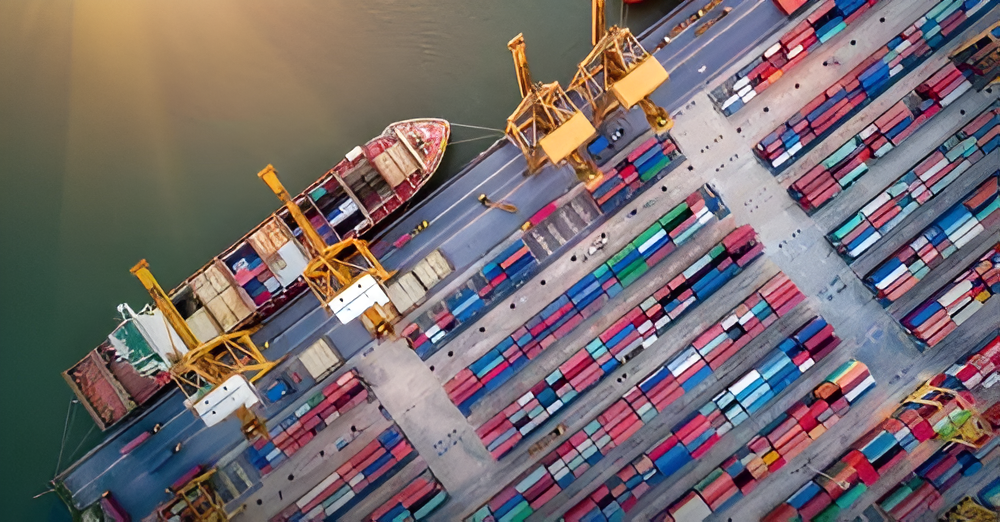
IMAGE: Maritime freight, illustrating the India–Israel cargo route. (Source: Balaji Exim/IndiaMART)
The nine companies identified in the report included both government-owned and private manufacturers. State-owned Munitions India shipped 1,000 155mm artillery shells to Israel Military Industries, an Elbit subsidiary that supplies the Israeli military. Among the private companies, Kalyani Strategic Systems sent the same recipient 9,600 shell casings, while state-owned Advanced Weapons and Equipment India supplied 120 mortar launchers. PLR Systems exported more than 43,000 feeding trays and bolt carriers, parts that load ammunition and cycle a firearm. Indo-MIM sent at least 59,637 automatic sears, the mechanism that permits automatic fire.
The trade also extended into rocket propulsion. Premier Explosives Limited was linked to a Chennai-origin shipment aboard the Borkum containing rocket motors and explosive charges for Israel Aerospace Industries. When the vessel approached Cartagena in May 2024, protests over its cargo led it to abandon the Spanish port call. Amnesty later sought details of Premier Explosives’ export licences and any assessment of the cargo’s end use, but India’s trade authorities did not respond.

IMAGE: The Borkum, which abandoned a planned call at Cartagena amid allegations that its India-origin military cargo was ultimately bound for Israel. (Source: Photo Marcial Guillén/EFE via El País)
Amnesty’s records captured only part of the trade. Using ImportGenius records covering 2019 to 2024, the Indian investigative magazine The Caravan traced a wider supply chain involving thousands of shipments by other Indian companies. Ace Inotec alone sent millions of small-arms components to Israeli buyers, while Solar Industries shipped hundreds of tonnes of RDX and HMX, high explosives used in military ordnance. The pipeline extended beyond Amnesty’s sample, and records show that it was already established before the war
Al Jazeera analysed more than 6.5 million entries in the Israeli Tax Authority database and identified 2,603 consignments of military-related goods entering Israel between October 2023 and October 2025, with a declared value of about $885.6 million. India accounted for roughly 26% of that value, ranking second only to the United States. Most strikingly, 91% arrived after the ICJ’s January 2024 order.
Ninety-one Indian customs documents from 2024 identify the Indian companies, the military cargo they shipped and the Israeli manufacturers that received it. Kalyani Rafael Advanced Systems sent Rafael 554,120 components described as “HEAVY FRAG,” parts designed to scatter metal when a munition detonates. Economic Explosives supplied Reshef Technologies with 99,400 booster pellets used to initiate larger explosive charges. Kalyani Strategic Systems exported 155mm projectile bodies to IMI Systems, while Ashoka Manufacturing sent munition metal parts to MCT Materials.
Israel was not simply one destination among many for India’s defence industry. India Exim Bank’s analysis of 2023 customs data recorded $358.6 million in Indian arms-and-ammunition exports, 36% of which went to Israel. The roughly $129 million share made it India’s largest market in the category. The share was greater in weapons parts, with Israel absorbing 60.4% of Indian exports, worth about $121 million. The scale of the trade gave New Delhi meaningful influence over the supply relationship and demanded more than routine scrutiny once the risk surrounding Israel’s conduct became known. India therefore possessed means it could use to help prevent genocide and a duty to exercise due diligence over military goods at foreseeable risk of misuse.
By the time the Gaza war began, India’s capacity to restrain its military relationship with Israel was complicated by its own reliance on Israeli weapons. Israel supplied 81% of India’s arms-and-ammunition imports in 2023 and 89% of those classified as bombs, grenades and torpedoes. When war strained Israeli production, Israel delayed roughly $1.5 billion in deliveries to other customers while protecting its supply pipeline to India. New Delhi was therefore being called upon to scrutinise and restrict a relationship on which its own military relied and which Israel treated as a strategic priority.
The first ICJ warning in January 2024 did not interrupt production at the Indian end of Israel’s drone supply chain. The following month, Shephard Media reported that the Adani-Elbit plant in Hyderabad had delivered more than 20 Hermes 900 drones to Israel. As the first facility to manufacture the aircraft outside Israel, the plant gave New Delhi a point of influence over supplies reaching the Israeli military. Known in Israeli service as the “Kochav”, the Hermes 900 is capable of carrying missiles and air-dropped bombs, including the Mikholit munition. A Disclose investigation found that Israel deployed the drone in large numbers over Gaza after 7 October 2023. Other reporting in India said the Hyderabad-assembled drones were intended for Israel’s wartime use. The Hermes 900 was being deployed extensively over Gaza for surveillance, targeting and attack missions

IMAGE: Adani-Elbit became the first company to manufacture the Hermes 900 MALE UAV outside Israel. (Source: Indian Defence Times/Instagram)
Adani later confirmed to The Wire that the plant had exported aerostructures and subsystems for more than 20 drones, an indication that India never considered the ICJ’s warning sufficient reason to interrupt the supply relationship.
By December 2025, India was supplying warhead assemblies for a weapons programme already linked to civilian harm in Gaza. Investigators had documented SkyStriker remains in Khan Younis, while Airwars had recorded civilian casualties in a strike involving the system. Yet Alpha Elsec, an Indian venture linking Alpha Design Technologies with Israel’s Elbit Systems, shipped 122 Indian-made assemblies matching the SkyStriker’s five-kilogram warhead months after those findings were public and nearly two years after the first ICJ warning. The shipment showed the supply relationship continuing even as the risk attached to its end use became more specific.
In India, anger over the arms route was growing among the workers expected to keep it moving. In February 2024, the Water Transport Workers Federation of India, representing more than 3,500 workers at eleven government-owned ports, told members not to handle weaponised cargo connected to the war. In May, Spain denied entry to the Marianne Danica, which had sailed from Chennai carrying about 27 tonnes of explosive or military material bound for Haifa.

IMAGE: The Marianne Danica, one vessel in India’s military supply chain to Israel. (Source: amSeehafen)
The route had become the subject of organised resistance at Indian ports and official intervention abroad, making the destination and wartime purpose of the cargo matters of public record rather than facts hidden inside export paperwork. Workers recognised the route and tried to obstruct it. The weapons still left India.
Built for the long term
The cargo records had already established the question at the heart of both legal tests. India knew what was moving and had the power to intervene. What lay beyond the border gave New Delhi even more influence. Its military self-reliance campaign had drawn Israeli contractors into Indian factories, where export deals became joint ventures, licensed production and shared technology.

IMAGE: Adani and Elbit inaugurate India’s first private UAV manufacturing facility in Hyderabad. (Source: The News Minute)
The largest Israeli arms companies had become part of the industrial base New Delhi was building. Adani and Elbit produced drones in the southern Indian city of Hyderabad, while Kalyani and Rafael worked together on missile systems and components. The same integration reached the public sector through Bharat Electronics’ work with Israel Aerospace Industries on air defence. Tata Advanced Systems and IAI formed a venture covering missiles, radars and electronic warfare, while Mahindra Aerostructures partnered with Elbit Systems Cyclone, a wholly owned Elbit subsidiary. Each arrangement placed more Israeli production inside Indian companies and more of the relationship within reach of Indian policy.
Behind those partnerships stood the Indian state. Its presence ran through the factories as well as the decisions that kept their products moving. The Israeli footprint extended into the state-dominated core of India’s defence industry, where India Exim Bank reported that public-sector entities and their joint ventures produced 79.1% of national defence output in 2023–24. Israeli contractors used that state-backed expansion to secure local production, joint ventures and access to public-sector capacity, all within institutions New Delhi owned, licensed or had the power to direct.
The ICJ’s warnings over Gaza did not prompt New Delhi to reconsider its defence relationship with Israel. India instead created new institutions that made the partnership more permanent. In October 2024, state-owned Bharat Electronics and Israel Aerospace Industries incorporated BEL IAI AeroSystems to provide long-term support for India’s Medium Range Surface-to-Air Missile systems. The missile had been developed jointly by India’s Defence Research and Development Organisation and IAI, and BEL noted that it was used by all three Indian armed services and the Israeli military. One year into the war, the two state-owned arms companies had turned cooperation around a shared weapons system into a permanent company.

IMAGE: BEL IAI AeroSystems announced the start of its operations at Aero India 2025 in Bengaluru on 11 February 2025. (Source: Aviation Defence Universe)
Two months later, DRISHTI, an accelerator created to bring Israeli military and dual-use technology companies into the Indian market, opened in Hyderabad. Run by T-Hub with Israel’s Directorate of Defense Research and Development (DDR&D) and the US-linked Motwani Jadeja Foundation, the programme offered Israeli companies access to Indian manufacturers, investors and potential military customers. Its first group included Airobotics, a wholly owned subsidiary of US-listed Ondas, whose Israeli operations were already expanding through contracts, government funding and work with the country’s defence establishment. Airobotics had announced that it was accelerating development of the Iron Drone Raider to meet the needs of the Israel Defense Forces (IDF) and Israeli homeland-security forces during the Gaza war. Israel later selected the company for an autonomous drone programme and added it to a tender for thousands of tactical attack drones. DRISHTI did not connect those projects to Gaza. It brought a company already responding to Israel’s wartime demands into an Indian ecosystem shaped by state manufacturers, public policy and government-controlled military procurement.
In July 2026, DRISHTI 2.0 expanded the programme and added a dedicated route for mature Israeli companies with market-ready systems. What began after the ICJ’s warnings was noticeably being enlarged rather than reconsidered
On 14 August 2026, Israel’s Defence Ministry described the connection between Indian industrial capacity and Israeli military power openly. Speaking to the Indian defence-industry publication Raksha Anirveda, ministry director general Amir Baram called defence exports “an engine of the IDF’s force build-up” and said India was “central to our eastward expansion.” India’s role was no longer being presented merely as a market for Israeli weapons. Its scale, factories and partnerships were part of how Israel intended to strengthen the industry supplying its armed forces.
Israel Aerospace Industries chief executive Boaz Levy described how war contributed to that business. “The war that we faced in the last two years enables most of our products to become valid,” he told DefenseTech Week in Tel Aviv in December 2025. “Starting with Gaza and moving on to Iran and to Yemen, I would say that many, many products of IAI were there.” Eighty per cent of IAI’s business was for export, he added, and lessons from the war would shape its “future business capabilities.” Gaza had entered the sales case for weapons marketed abroad, while those sales helped finance and reinforce the force that used them. The relationship between the weapons, their use and the military capacity they sustained was not hidden from Israel’s partners. It was the basis on which the partnership was being sold.
Gaza had entered the sales case for weapons marketed abroad.
The Haifa connection
Adani’s position stretched from the Hyderabad drone plant to Israel’s Mediterranean coast. Through Adani Ports, it controlled 70 percent of the original Port of Haifa, acquired together with Israel’s Gadot Group for about $1.15 billion in January 2023. The Adani–Gadot consortium acquired 100% of Haifa Port Company Ltd from the Israeli government. Adani Ports and Special Economic Zone Ltd now holds 70%, while Israel’s Gadot Group holds 30%.
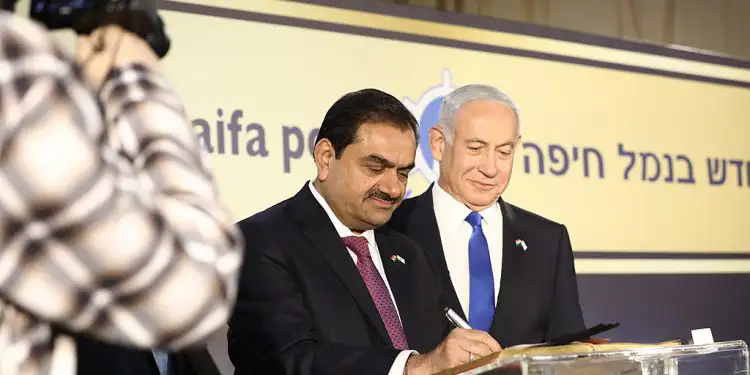
IMAGE: Indian Billionaire Gautam Adani and Prime Minister Benjamin Netanyahu at the signing ceremony of the new Haifa Port, January 2023. (Source: Michel Dot Com via Israel Hayom)
Haifa was already familiar territory to India’s military. Indian warships made repeated calls there between 2012 and 2018, combining visits with meetings and exercises involving the Israeli Navy. The commercial port stands beside Israel’s principal naval base, home to the Dolphin-class submarine fleet, vessels widely reported to provide a sea-based nuclear second-strike capability.
A Chinese state-owned company already operated the neighbouring Bayport terminal, and Washington reportedly opposed further Chinese control near an Israeli naval base and a port used by the US Navy. Adani and Gadot emerged as a strategically acceptable alternative, winning with a bid reportedly 55 per cent above their nearest competitor. The acquisition also placed an Indian company at the proposed Mediterranean end of the India–Middle East–Europe Economic Corridor, where Haifa would connect trade moving from India through the Gulf to Europe. India was no longer only Israel’s defence partner. Through Adani, it had acquired a commercial stake in Haifa’s role as the corridor’s connecting node.
During the war, the Adani-controlled commercial port became part of Israel’s military supply chain. In February 2025, during a temporary ceasefire in Gaza, Haifa received tank and armoured-vehicle parts valued at $16.6 million, the largest single weapons-related import identified in Al Jazeera’s analysis of Israeli customs records. The records did not disclose its country of origin, exact contents or end user. Five months later, dozens of US-made D9 armoured bulldozers and other ground-force equipment were unloaded at Haifa and transferred to the Israeli military. During the wider regional war in 2026, cargo ships docking at Haifa and Ashdod formed part of a 24-hour operation that delivered 6,500 tonnes of US military equipment, including munitions, military trucks and armoured vehicles.
Adani did not control the naval base next door. But the same conglomerate that supplied Israel’s drone programme now controlled the commercial port through which wartime military cargo entered the country. India’s role stretched from weapons production to the infrastructure that received them. By then, the legal warnings against continued support were already mounting.
The warnings
The ICJ’s order of 26 January 2024 found that at least some of the rights claimed under the Genocide Convention were plausible and that they faced a real and imminent risk of irreparable harm. The Court did not decide whether Israel had committed genocide, but the danger was grave and urgent enough to require provisional measures.

IMAGE: The ICJ courtroom on 26 January 2024, when the first warning became a binding order. (Source: UN Photo/ICJ//IHL Center/Frank van Beek)
By March, conditions had deteriorated further. The Court found that famine was setting in and imposed additional provisional measures requiring Israel to enable the unhindered provision of urgently needed aid and basic services.
In April, the UN Human Rights Council called for accountability for violations of international human rights and humanitarian law in Gaza and urged states to stop transferring arms to Israel. India abstained. Before the month was over, Munitions India had applied for permission to fulfil another Israeli order. The warning had reached New Delhi but failed to interrupt the machinery of supply.
The warnings soon reached both the government and the courts. On 30 July, former judges, diplomats, civil servants and writers urged Defence Minister Rajnath Singh to cancel existing arms-export licences for Israel and halt new ones. A petition then asked the Supreme Court to cancel existing licences and halt new ones for Indian companies exporting arms and military equipment to Israel. However, the Court declined to intervene, leaving export policy to the executive and citing potential contractual consequences for Indian companies. Strangely, the court did not rule that the exports were lawful.
India’s own export-control rules already required officials to confront the questions Gaza made urgent. Each application had to be assessed against the stated end use—the reliability of the recipient, the integrity of the supply chain, the timing of the transfer, the recipient state’s weapons programmes and India’s treaty obligations. The government had both the authority and the means to demand assurances and verify how exported weapons were used. To this day, its deliberations have remained confidential, and it has produced no public evidence that it did either.
On 2 May 2024, India’s public tracker for applications involving controlled military and dual-use goods still identified Israel as the destination for relevant export applications. The Directorate General of Foreign Trade published the live status of those applications through a Google Sheet linked from its website. By 30 July, the destination field had disappeared. Former Supreme Court judges and other prominent citizens asked the defence ministry to restore it.
The government offered no public explanation, and when Amnesty later sought export information directly, its September 2025 Right to Information request went unanswered.
By then, the warning had sharpened. A UN commission of inquiry concluded in September 2025 that Israel committed genocide in Gaza. The following month, UN Special Rapporteur Francesca Albanese named India among states sustaining Israel’s military capacity.
On 4 November 2025, less than two months after the UN commission’s finding and two weeks after India was named among the states sustaining Israel’s military capacity, Defence Secretary Rajesh Kumar Singh and Israeli Defence Ministry Director General Amir Baram signed a memorandum expanding cooperation in training, defence production, research, artificial intelligence, cybersecurity, co-development and co-production. Alpha Elsec shipped the SkyStriker-specification warheads the following month. In February 2026, Narendra Modi and Benjamin Netanyahu elevated relations to a Special Strategic Partnership, declaring that defence cooperation had grown in “scope and scale” and setting out “a vision and a roadmap” for its future. Modi told Israel’s parliament that India stood with Israel “firmly, with full conviction, in this moment, and beyond.”

IMAGE: After the warnings, India and Israel elevated their strategic partnership during Modi’s visit to Israel in 2026. (Source: BBC)
Each step followed explicit warnings already delivered to New Delhi. The government could no longer plead ignorance, and it retained the power to restrict arms exports, direct state-owned manufacturers and condition further defence cooperation. Its decision to use none of those levers can now be measured against the two legal tests that follow
Test one: prevention
The duty to prevent genocide is measured by what a state does when the danger becomes clear. Under Article I of the Genocide Convention, India is legally bound to prevent genocide. Once it knew, or should have known, of a serious risk that genocide would be committed, the International Court of Justice required it to employ all means reasonably available to it.
By January 2024, India could no longer plausibly deny knowledge of that risk. The ICJ’s first order was followed by additional provisional measures in March and a Human Rights Council resolution in April calling on states to cease transfers of arms, munitions and other military equipment to Israel. In July, former judges, diplomats and other prominent Indian citizens urged Defence Minister Rajnath Singh to cancel existing export licences and issue no new ones. The issue reached the Supreme Court in September. The UN Commission of Inquiry’s subsequent conclusion that Israeli authorities and security forces had committed and were continuing to commit genocide removed any remaining basis for claiming ignorance of the danger.
India was not a powerless observer. It owned some of the exporters, controlled the export-licensing system and presided over a defence sector in which public entities and their joint ventures accounted for 79.1 per cent of production in 2023–24. Its strategic-trade controls made military and dual-use exports subject to government authorisation. Israel was India’s largest arms-and-ammunition export market in 2023, while Israeli customs records later placed India second only to the United States in the declared value of military-related goods entering Israel during the war. India was also sufficiently important to Israel’s defence industry that deliveries to it continued while $1.5 billion in Israeli exports to other customers were delayed.
New Delhi could refuse export authorisations, halt transfers by state-owned companies, demand end-user guarantees, verify the use of exported material and condition future contracts on restraint. Its own licensing rules required officials to consider the recipient, intended use, supply chain, timing, weapons programmes and India’s treaty obligations. The Supreme Court confirmed that Indian law gave the Union government sufficient power to act, including by prohibiting exports under the Foreign Trade Act and the Customs Act. The question was never whether New Delhi could act. It was whether it would.
Each warning gave India another opportunity to change course. Each time, the military relationship moved in the opposite direction. After the ICJ’s first order came Munitions India’s repeat-order application and shipments including hundreds of thousands of fragmentation components and booster pellets documented in Amnesty International’s investigation. The government then established the BEL–IAI joint venture and joined Israel’s defence establishment in creating DRISHTI, an accelerator for technologies with military applications. After the UN Commission found genocide came a defence-cooperation memorandum, a SkyStriker-specification warhead shipment and the elevation of bilateral ties to a Special Strategic Partnership.
This was not a failure born of ignorance, distance or powerlessness. India knew of the risk, controlled the channels through which military goods moved and retained the legal power to close them. Yet as the warnings hardened, from provisional measures, to demands for an arms embargo to a UN finding of genocide, India sustained the transfers and expanded the partnership.
India had the knowledge, the leverage and the power to act, yet it chose instead to keep military supplies moving and deepen the partnership as the evidence of genocide mounted.
Test two: due diligence
Common Article 1 of the Geneva Conventions requires states to respect and ensure respect for the laws of war in all circumstances. The International Committee of the Red Cross interprets that obligation as one of due diligence. States must use the means available to prevent serious violations by others. In Nicaragua v. Germany, the International Court of Justice reminded every state supplying weapons of its obligation to avoid the risk that those weapons might be used to violate the Geneva Conventions or the Genocide Convention.
India did not need to share Israel’s purpose to incur responsibility. It needed only to continue military support despite a foreseeable risk that the weapons, components and technology it supplied would facilitate war crimes, grave breaches or acts prohibited by the Genocide Convention. By early 2024, that risk was no longer speculative. India was required to test every transfer against it.
Its strategic-trade control system gave officials the means to do so. They could examine the timing of an export, its stated end use, the chain from supplier to recipient, the recipient’s weapons programmes and India’s treaty obligations. They could demand end-user certificates and post-shipment documentation, verify compliance and suspend or revoke authorisations. Those powers placed responsibility for each approved transfer squarely with the Indian state.
The transfers continued. Shells, fragmentation components, explosive initiators, drone-linked production and warhead assemblies moved through a system whose purpose was to stop sensitive goods from reaching an unlawful use. The government has disclosed no Gaza-specific risk assessment, no general suspension and no explanation of how those transfers survived the scrutiny its own rules required. It has not identified a single licence refused, suspended or cancelled because of the risk in Gaza.
As that risk intensified, scrutiny weakened. Destination details disappeared from the government’s public tracker between May and July 2024. Amnesty International’s subsequent request for information went unanswered. When the government eventually invoked its “robust legal and regulatory framework,” it did not reveal what evidence officials considered, what end-use assurances they obtained or how they concluded that continued transfers were lawful. The framework became the government’s defence precisely when it stopped showing how the framework worked.
Germany’s military-equipment export licences for Israel fell from approximately €200 million in October 2023 to €24 million in November and approximately €1 million by March 2024. The ICJ recorded that decline when assessing Germany’s conduct. The comparison does not absolve Germany. It establishes that a supplier confronting escalating risk could reassess its decisions and impose measurable restrictions. India has shown no comparable reassessment because its conduct reveals none.
India had the warnings, the information and the legal machinery to intervene. Yet its controls produced no disclosed refusal, suspension or cancellation while the flow of military goods continued. Its claim to a “robust” framework cannot satisfy due diligence when the government will not show that the framework restrained a single transfer. India did not use its controls to confront the risk. It used their existence to defend the pipeline they failed to stop.
India cannot claim due diligence merely because controls existed on paper. Due diligence is measured by what those controls prevented. Here, they prevented nothing that New Delhi has been willing to identify, while weapons and military components continued to move despite an escalating and foreseeable risk of atrocity. That is not due diligence. It is recklessness under state authority, sustained in the face of known danger and mounting evidence of atrocity.
The complicity question
India’s failure to prevent genocide and its reckless disregard of due diligence form a sustained course of conduct in which New Delhi knew the danger, possessed the power to restrict military support and chose to preserve the relationship as the evidence of atrocity mounted.

IMAGE: What the machinery of partnership left behind in Gaza. (Source: B’Tselem)
Complicity carries a higher threshold and turns on the knowledge and intent accompanying that assistance. The records most capable of establishing the government’s state of mind remain concealed inside licensing assessments, ministerial deliberations, end-use certificates and communications with Israeli recipients. Their secrecy prevents a final legal determination, but it cannot neutralise the conduct already established.
India was not confronted with one shipment, one warning or one isolated decision. It repeatedly authorised, enabled and expanded military cooperation after the risk became impossible to deny. Every approval allowed more weapons, components or military technology to enter a campaign whose consequences were already visible in Gaza.
A court may ultimately decide whether the concealed record crosses the legal threshold for complicity, but the moral judgment does not require access to a government file. India saw civilians killed, families displaced, neighbourhoods erased and hunger used against an imprisoned population. It had the influence to press for restraint and the legal power to restrict the military support within its control. Instead, it protected and deepened the relationship that kept that support moving, enabling the machinery of war and making India a participant in the suffering imposed on the people of Gaza. India’s responsibility lies not only in what it failed to prevent, but in what it chose to sustain while Gaza was being destroyed.
READ MORE INDIA NEWS AT: 21st Century Wire India Files
SUPPORT OUR INDEPENDENT MEDIA PLATFORM – BECOME A MEMBER @21WIRE.TV
VISIT OUR TELEGRAM CHANNEL