
Freddie Ponton
21st Century Wire
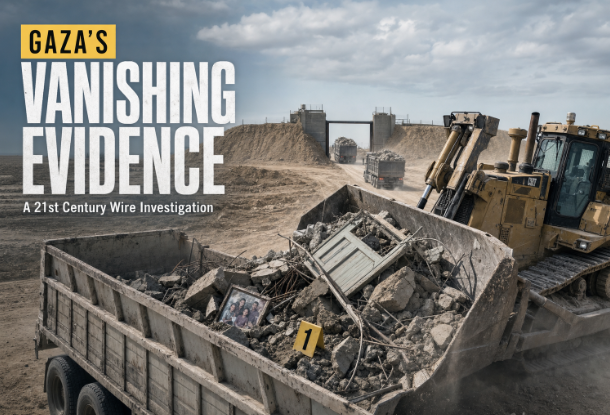
At least ten million tonnes of rubble have been removed, crushed or displaced from their original locations across the roughly two-thirds of Gaza under Israeli military control. That is the finding of a report published on 3 August 2026 by the Euro-Mediterranean Human Rights Monitor, a Geneva-based organisation that has spent the past two years cataloguing the war’s physical toll. Nearly a hundred trucks leave Gaza every day. They haul debris to sites inside Israel, and further south into the occupied West Bank, that nobody outside the Israeli military has been permitted to see.
This is happening in areas that hold the last physical traces of mass killing, forced displacement and genocide, at the exact moment the International Criminal Court is pursuing cases arising from the arrest warrants it issued against Israel’s prime minister and former defence minister, and while the International Court of Justice hears South Africa’s genocide case against the Israeli state itself. Gaza’s Civil Defence estimates that roughly 8,000 people remain missing, most of them buried under rubble that is now being crushed, mixed and trucked away before anyone can look for them.
The World Bank–UN–EU assessment jointly calculated in April 2026 that Gaza contained 68 million tonnes of debris, a figure that predates the demolition that has continued since. Almost none of it has been cleared under any documented, monitored program. The United Nations Development Programme, working with UNMAS explosive-ordnance teams and Palestinian labourers, has run a risk-managed debris-removal operation since early 2025, screening for unexploded munitions and channelling crushed material into road repair and shelter foundations.
By July 2026, OCHA reported that cumulative UN figures put its total at just under 630,000 tonnes cleared. UNDP has said that clearing most of Gaza’s rubble, under the right conditions, would take seven years. The two figures are not perfectly like-for-like; OCHA’s total tracks debris formally cleared under a risk-managed programme, while Euro-Med’s estimate combines material removed, crushed or displaced more broadly, but even allowing for that difference, the properly resourced, internationally coordinated, forensically screened programme has processed an amount equivalent to less than seven percent of what Israeli forces and civilian contractors have moved on their own, unsupervised, in a fraction of the time.
VIDEO: UNDP teams process rubble at a monitored crushing site in Deir al-Balah, October 2025. (Source: UNDP)
.
Israel and the Trump administration call this reconstruction. President Trump unveiled plans for a “New Gaza” of high-rises at Davos in January 2026, and Jared Kushner told the same audience that removal and demolition work had “already started,” the BBC reported. The reconstruction that debris clearance is supposedly clearing the way for does not exist at any meaningful scale. The pilot housing project near Rafah, the only concrete proof of the entire plan, has yet to prove anything. The first construction contract associated with the plan’s governing board was not for displaced Palestinian families at all. In fact, it was for a military base.
The pace and scale of that clearance is driven by unaccountable private units and contractors, and by an American decision that armed them with the equipment to do it. It also documents a second, largely overlooked dimension to the crisis. Israel is not only taking material out of Gaza, but it has also been putting material in, dumping Israeli construction waste onto Gaza soil through at least one crossing point, according to Haaretz, with no independent oversight and no public accounting. Together, these two flows describe a single, barely supervised logistics system running across Gaza’s perimeter in both directions, reshaping the ground where evidence of the war’s worst crimes may still lie, before anyone with the authority or the mandate to look has had the chance.
A Court Order Already Broken
Israel is facing a body of binding international law that speaks to this exact situation. Much of it was issued before the current clearance operation even began. In January 2024, the International Court of Justice (ICJ) ordered Israel to take effective measures to prevent the destruction of evidence tied to the Genocide Convention, in its 26 January 2024 order, and to stop restricting access for fact-finding missions and international bodies seeking to preserve it. Four months later, in a separate ICJ order, the court went further, requiring Israel to ensure unimpeded access to Gaza for any UN-mandated commission of inquiry investigating genocide allegations, specifically so evidence could be retained. Legal scholars called that access provision unprecedented in the court’s history.

IMAGE: ICJ President Nawaf Salam delivers the court’s order requiring Israel to grant UN-mandated investigators unimpeded access to Gaza, 24 May 2024. (Source:: ICJ/UN Web TV)
The Rome Statute adds a separate layer of exposure. Article 70 criminalises the intentional destruction of, tampering with, or interference in the collection of evidence connected to the court’s proceedings, an offence against the administration of justice in its own right, independent of and additional to any underlying war crimes or genocide charge.
Whether the current clearance operation meets that threshold would require investigation into intent and knowledge, but the offence exists independently as a possible additional basis for scrutiny, and it sits alongside the arrest warrants the ICC issued in November 2024 against Benjamin Netanyahu and his former defence minister Yoav Gallant. A UN Commission of Inquiry report in May 2024 had already found that Israeli authorities prioritised notifying families and allowing burials over forensic investigation, and evidence of crimes went uncollected and unpreserved as a result.
This isn’t a resourcing problem, and a properly funded system for dignified recovery already exists. UNDP and the European Union announced a joint project on 9 July 2026 to fund debris management and nationally-led forensic investigation capacity in Gaza together, under the same initiative. A debris-management framework endorsed in January 2025 by UN agencies, international NGOs, and mine-action and cultural-heritage specialists requires risk assessments, safeguards for human remains, and protection of evidence before any removal takes place. Israel’s military-authorised clearance bypasses that system entirely, while a court order requiring the opposite remains formally in force.
The Men Doing the Work, and Who Profits From It
The physical demolition inside Israeli-controlled Gaza has been carried out in significant part by an irregular military unit known as Force Uriah, or Unit 2640. It was formed in October 2024 under the command of the army’s Gaza Division, made up largely of reservists and civilian settlers, described by Haaretz as a “rogue force”, rather than standard combat engineers. Its founder, Uriah Loverbaum, was not a career military engineer; he was a longtime settlement-movement operative who chaired the Young Settlement Forum, headed the Gush Etzion Fund, and ran election operations for the religious-nationalist Bayit Yehudi party.
Hebrew-language reporting traces the unit’s origin to a shortage of military engineering equipment caused by the Biden administration’s partial arms embargo, which had blocked new bulldozer imports and left existing fleets worn down. The army turned to civilian contractors it could not otherwise field.
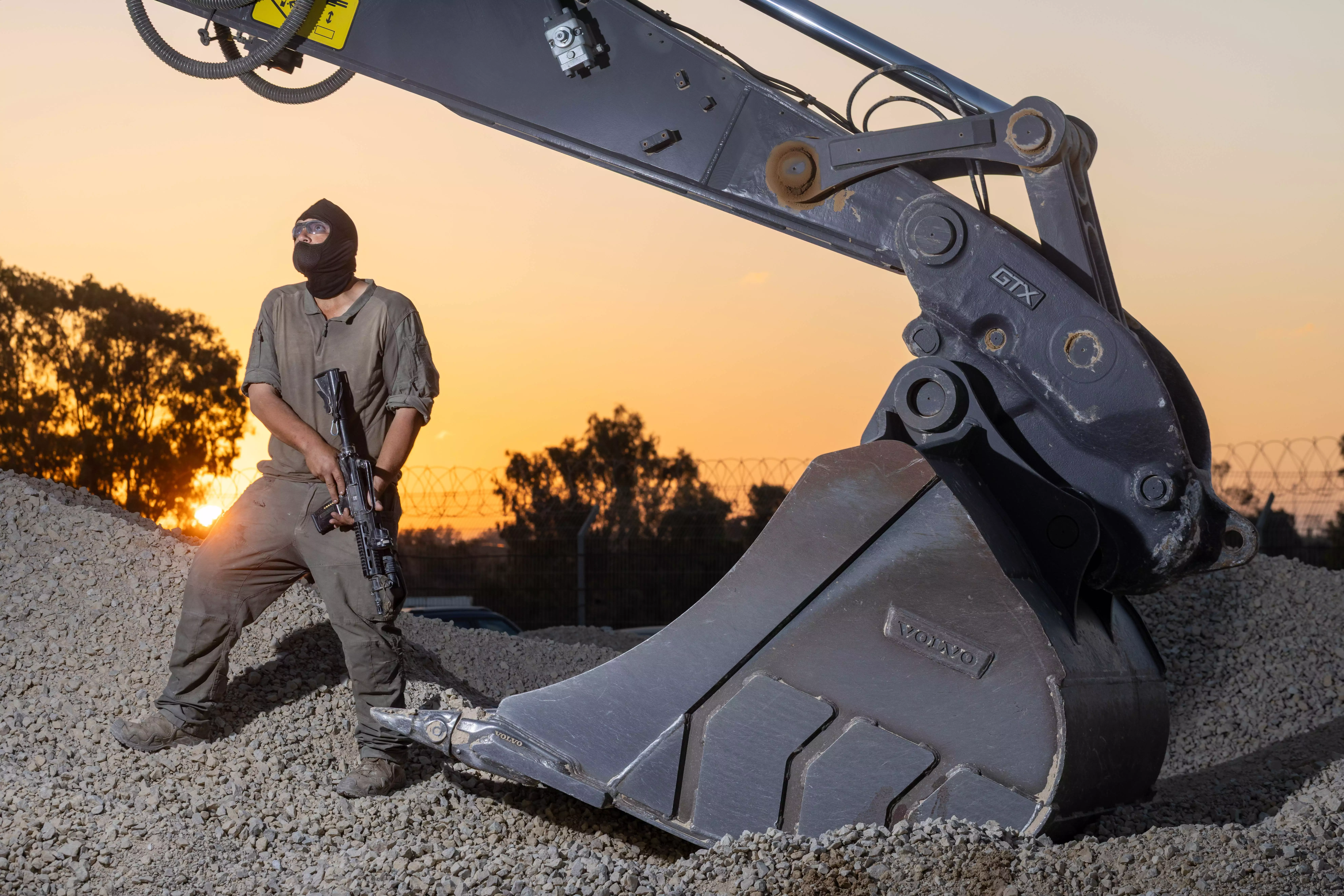
IMAGE: Lt. Col. (res.) Oriya (Uriah in English), Force Uriah’s commander at Camp Re’im after a day in the field, September 2025. Photo: Yossi Aloni/Makor Rishon. (Source: Yossi Aloni/Makor Rishon)
The unit’s own operators have stated its purpose plainly. After a reservist named Avraham Azulai was killed in Khan Younis in July 2025, unit members demolished 409 buildings during the mourning period that followed. WhatsApp groups tied to settlement organisers described the work at the time as preparing the ground for Jewish settlement in the Gaza Strip.
The demolition economics followed the same logic. Defence Ministry contractors were paid either by the day or by the building. Equipment owners received between 5,000 and 5,500 shekels a day, while other contracts paid 2,500 shekels for buildings of up to three floors and 5,000 for taller structures. Operators were hired separately; one told Haaretz he earned 30,000 shekels a month, with a company car and accommodation. The more buildings demolished, the more the equipment owners earned. One contractor whose branded equipment appeared in footage after Azulai’s death, Ayash Earthworks (“עייש עבודות עפר”), had also carried out infrastructure work at the Evyatar settlement outpost for Daniella Weiss’s Nachala movement. Gaza demolition and West Bank settlement construction ran through the same commercial actor.
Oversight of the unit’s logistics fell to Betzalel Zini, brother of incoming Shin Bet chief David Zini. He held the permits controlling which convoys of heavy machinery entered Gaza. In February 2026, he was indicted on charges including aiding the enemy, bribery and smuggling. Prosecutors accused him of exploiting his logistics authority to move cigarettes to Hamas-linked buyers through the Sufa crossing, part of a ring police said had funnelled hundreds of millions of shekels. A judge released him to house arrest the following month, ruling the evidence did not meet the threshold for the most serious charges. He denies all charges.
The unit’s own commander told Makor Rishon that “every building we destroyed in Gaza is one less dead soldier,” a blanket justification for levelling entire neighbourhoods rather than a case-by-case account of buildings found to conceal tunnels or explosives. The charges do not prove the demolitions were corrupt, but they expose a system vulnerable to abuse and shielded from scrutiny. The unit was later disbanded, and by then, Washington had reopened the supply of the machines on which operations like it depended.
Washington Reopened the Bulldozer Pipeline
The equipment that made much of this possible came through a decision made in Washington. In late 2024, the Biden administration held back roughly 134 armoured Caterpillar D9 bulldozers destined for Israel, citing explicit concern over how the vehicles were being used to demolish homes in Gaza.
Five days after his January 2025 inauguration, Trump lifted the hold. Dozens of the previously delayed bulldozers arrived at Haifa port that July, part of what the State Department called reversing an embargo that had “wrongly withheld” weapons from Israel. His administration had meanwhile approved a separate proposed sale of D9 bulldozers worth 295 million dollars, invoking emergency authority to bypass congressional review as part of nearly four billion dollars in expedited military assistance justified through a declaration citing threats from Iran and terrorism. Reconstruction was never mentioned in either transaction.
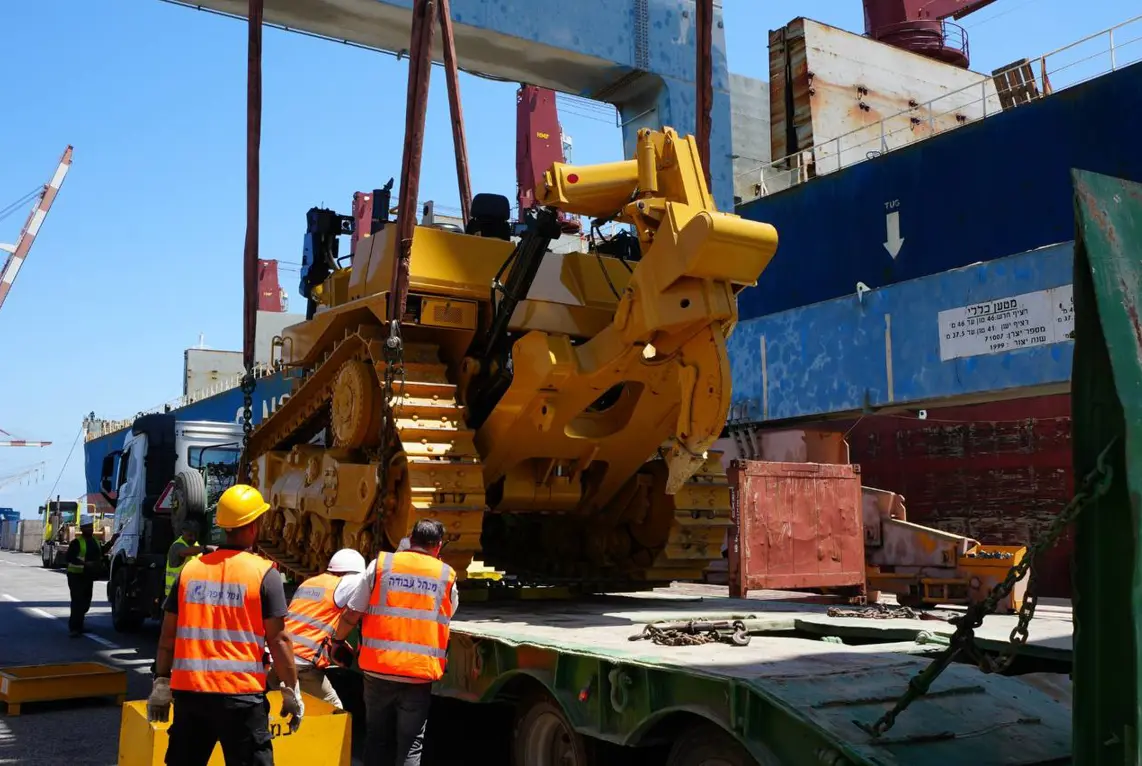
IMAGE: Caterpillar D9 bulldozers shipped from the United States arrive at Haifa port after the Trump administration lifted the Biden-era hold, 9 July 2025. (Source: Israeli Ministry of Defence)
By lifting the hold, Washington restored the flow of demolition equipment to a system in which messages circulated in settler-linked WhatsApp groups described the destruction as “preparing the ground for Jewish settlement in the Gaza Strip.”
Clearing Continues, Rebuilding Does Not
By January 2026, the Israeli military had already confirmed that at least seventy percent of rubble-removal operations in Rafah were complete, despite indications that hundreds of bodies remained beneath destroyed buildings, streets and agricultural land. Al Jazeera’s satellite analysis later found that rubble removal had essentially stopped in Rafah and Beit Hanoun, the two areas actually designated for reconstruction, even as clearance continued around strategic military positions elsewhere. Clearing continued at specific strategic points, including a hilltop position in Shujayea and outposts around Khan Younis. The pilot housing project near Rafah, meant to prove the whole plan works, is a small cluster of portable cabins, and officials say it is unlikely to be functional before the end of 2026.
READ MORE: The Board That Abandoned Gaza’s Reconstruction Now Wants to Govern It (The Cabin State)
The Board of Peace, the body Washington created to oversee Gaza’s rebuilding, was reported in early August 2026 to have provisionally selected Arkel International, a “Louisiana-based firm that has previously carried out work with the US government in countries such as Iraq”, for what officials called its first construction contract. However, the agreement had not yet been finalised, and the planned project is clearly not Palestinian housing but a rudimentary military outpost for roughly 150 Moroccan troops joining a proposed international stabilization force. So far, not one displaced Palestinian family has been housed under it.
Commercial interest already extended beyond construction. Gothams LLC, an American disaster-response contractor involved in operations at Florida’s “Alligator Alcatraz” detention facility, submitted a proposal to manage humanitarian and commercial deliveries into Gaza through a single logistics network. A draft obtained by the Guardian would have allowed the company to charge for every truck entering Gaza and for access to its warehouses and distribution system. It also sought seven years of exclusivity and a guaranteed minimum threefold return on capital expenditure. Gothams said the proposal had been put on hold and that no agreement or contract was in place.
Asked directly for evidence of reconstruction progress, a Board of Peace spokesperson offered none, saying the board “continues to work with partners to move from planning to implementation.” Aid workers granted anonymity for their safety called the entire framework a mirage, and said some Israeli officials had told them privately they would prefer Gaza remain in ruins. Clearing has continued at the same pace, mostly in areas where no rebuilding is planned.
Clearing has continued at the same pace, mostly in areas where no rebuilding is planned. Where nothing is to be rebuilt, “clearing” means erasure. Israeli commanders have said so themselves:
“There Is No More Abasan”
Gil Werner, the commander of the Gaza Division’s Southern Brigade, described what his forces had done to two Palestinian towns in an interview with Makor Rishon, as reported by The New Humanitarian. “There is no more Abasan and no more Bani Suheila,” he said. “That’s where the people who attacked Nir Oz and Nirim came from. We occupied all of this area, and now it’s hard to imagine what it looked like before. There are no people here; there is nothing.”
Two legal scholars, interviewed by The New Humanitarian, reached related but distinct conclusions. Adil Haque of Rutgers called demolition on this scale during a ceasefire a failure of any legitimate test of military necessity or proportionality. Muna Haddad of the Palestinian rights group Adalah went further, saying the language matches the legal definition of genocide, deliberately inflicting conditions calculated to destroy a population physically.
The satellite record backs the words. Israel’s military footprint in Gaza expanded from 54 to 65 percent of the territory in the months following the October 2025 ceasefire, during a period when the justification of immediate combat operations had substantially receded. A cemetery in Khan Younis’s Maan area, Sheikh Mohammed, was bulldozed and became a military installation between November 2025 and May 2026, with vehicles now parked over demolished graves, echoing an earlier pattern.
In February 2024, Sky News analysis confirmed Israeli bulldozers operated directly on the grounds of Nasser Hospital in the days before more than three hundred bodies were found in a mass grave there. The New York Times found two of the three graves had been dug before the raid that Israel said uncovered them.
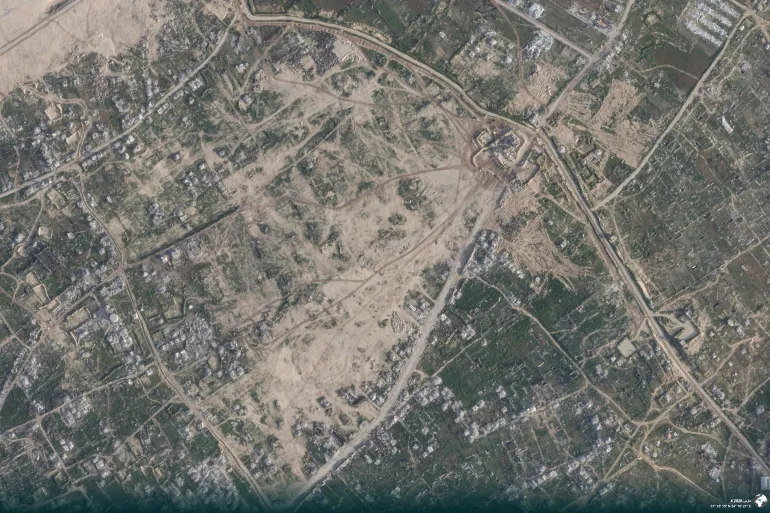
IMAGE: Satellite imagery shows reconstruction stalled in Rafah and Beit Hanoun while Israeli military fortifications expanded elsewhere. (Source: Al Jazeera Digital Investigations Unit; imagery: Planet Labs and Sentinel Hub)
Euro-Med’s warning about destroyed evidence and Werner’s account of towns wiped away describe the same process. In some places, the remains are crushed and hauled away, whilst in others, debris is dumped until the land no longer resembles what was there before
Haaretz reported in October 2025 that trucks belonging to a private company were crossing at Kissufim to dump construction waste from Israel inside Gaza, then returning empty for another load. Field commanders authorised the deliveries and allowed the drivers to unload along roadsides rather than at designated disposal sites. The Israeli military said it knew nothing about the operation.
משאיות ישראליות משליכות פסולת בתוך רצועת עזה pic.twitter.com/ZZSqOCKUdT
— הארץ חדשות (@haaretznewsvid) October 25, 2025
The company operating those trucks has not been identified. But an earlier Haaretz investigation showed how concentrated the private machinery business inside Gaza had become. Five firms dominated Defence Ministry rentals, namely the Talor Karadi Group, Asia Construction, the Olenik Group, Farm Earthworks and Development, and Eran Y.D. Each supplied dozens of machines. Talor Karadi operated a dedicated Gaza division whose teams entered with between eight and twelve machines and, according to its owner, could demolish nearly 100 buildings a day.
There is no evidence that Talor Karadi operated the dumping trucks. Its documented role exposes a different connection. The company already works in demolition, waste removal and recycling, and has since said it expects to compete for Gaza rubble contracts and could build a crushing plant inside the territory. A company paid to supply machinery for the destruction is now preparing to process what the destruction left behind.
There is no evidence that Talor Karadi operated the dumping trucks. Its documented role exposes a different connection. The company already works in demolition, waste removal and recycling, and has since said it expects to compete for Gaza rubble contracts and could build a crushing plant inside the territory. In June 2026, Walla reported that negotiations had begun with Israeli companies for large-scale demolition, debris removal and the conversion of crushed concrete into construction material. Walla did not identify the companies involved, so its report does not place Talor Karadi in those negotiations. It does confirm that a wider commercial market is forming around Gaza’s ruins. Talor Karadi is one documented example: a company paid to supply machinery for the destruction is now preparing to process what the destruction left behind.
Since the ceasefire, Israeli forces have built roughly twenty-five kilometres of earthen berms along the so-called Yellow Line, fortifying nearly forty military bases on the eastern side of Gaza. Around each base, rubble is cleared, access roads are paved and the berms are raised. The Associated Press reported that forces have levelled most buildings on the Israeli-controlled side, virtually erasing several towns and most of Rafah. Netanyahu has said the military now controls sixty percent of Gaza, with a directive to reach seventy. The clearance follows the military footprint, not the reconstruction plan. It removes the towns around the bases and fixes the Yellow Line into roads, berms and empty ground. A ceasefire marker is becoming a physical frontier.
Commercial plans are now forming around the rubble itself. Walla reported in June 2026 that Israeli companies were negotiating contracts to demolish buildings across Gaza, remove the debris and recycle the concrete as construction material. Israeli officials call this security infrastructure. But the roads, berms and bases are being built through the same process of demolition and rubble clearance documented by Euro-Med.
The Question Left Unanswered
At a UN press briefing on 4 August, Deputy Spokesperson Farhan Haq was asked whether the rubble operation violated the ICJ’s orders concerning the preservation of evidence and access for investigators. He acknowledged the Euro-Med reports and said that all authorities must comply with the court’s rulings, but left it to those authorities to interpret whether they were doing so.
VIDEO: UN Deputy Spokesperson Farhan Haq responds to questions about rubble removal and evidence preservation in Gaza, 4 August 2026. Go to 6m 54 (Source: United Nations)
.
Other international bodies have documented the destruction surrounding this operation without examining the removal of the rubble itself. The UN Commission of Inquiry concluded in June 2026 that there were reasonable grounds to find that the harm inflicted on Palestinian children formed part of a deliberate strategy to destroy the future of Palestinians in Gaza. Amnesty International separately investigated the destruction of thirteen Gaza City high-rises and found no evidence of fighters or military activity in the buildings when they were attacked. Neither investigation addressed what happened to the remains once the buildings were demolished. As of publication, this investigation could find no public filing in the ICC’s Palestine investigation or South Africa’s case before the ICJ addressing the rubble operation.
The unanswered question is not whether Gaza’s rubble must eventually be cleared. It is why millions of tonnes are being crushed and moved before the missing have been recovered, before the safeguards set out in the Gaza Debris Management Framework have been applied, and without a public record of what the trucks carry or where they unload it.
This investigation cannot establish what was carried in every truck or prove that destroying evidence was the purpose of the operation. It establishes that potential evidence is being altered and removed while the institutions capable of seeking its preservation have taken no public action. Courts can judge only the evidence that survives. In Gaza, that evidence may already be leaving by the truckload.
READ MORE PALESTINE NEWS AT: 21st CENTURY WIRE Palestine FILES
SUPPORT OUR INDEPENDENT MEDIA PLATFORM – BECOME A MEMBER @21WIRE.TV
VISIT OUR TELEGRAM CHANNEL