

Freddie Ponton
21st Century Wire
Israel’s campaign for observer status in Central America’s regional parliament is advancing in a Guatemala that already has a trade agreement with Israel, diplomatic contact with its municipalities and a record of purchasing from Israeli suppliers.
In Buenos Aires, the president of Central America’s regional parliament said she could win the two-thirds vote needed to grant Israel observer status. Six weeks later, Israel’s advocates had a caucus inside the chamber, giving the campaign a way in even though Guatemala had not signed the Isaac Accords.
Karla Gutiérrez told legislators in Buenos Aires on 29 June 2026 that she was working to make Israel an observer in the Central American Parliament, known as PARLACEN, and said she could secure the two-thirds majority required for approval by October. “I can do it,” she said at a conference convened by the Israel Allies Foundation and American Friends of Isaac Accords (AFOIA). The Genesis Prize Foundation helped establish AFOIA to promote the initiative across Latin America.
Karla Gutiérrez has emerged as the institutional face of Israel’s PARLACEN strategy. As the parliament’s president, she publicly championed Israel’s observer-status bid at a conference linked to the Isaac Accords network, then an Israel Allies caucus opened inside the very body she leads. Gutiérrez called Israel’s observer-status bid an “unprecedented achievement” that could open “a new chapter for Israel in the region.” According to JNS, she made the remarks in Buenos Aires at the Israel Allies Foundation’s Latin America Chairman’s Conference, telling lawmakers she was guided by faith and shared “Judeo-Christian values.”
“Now I know why God allowed me to be president,” she said. “It’s through a commitment to Israel.”
On 11 August, the Israel Allies Foundation launched an Israel Allies Caucus in PARLACEN’s plenary hall in Guatemala City, giving the observer-status campaign a permanent platform inside the chamber. Gutiérrez said she would lobby for a vote as early as the following month, while IAF president Josh Reinstein said the caucus was actively advancing recognition. The conference organiser now had a working group inside the parliament where Gutiérrez needed a two-thirds majority.
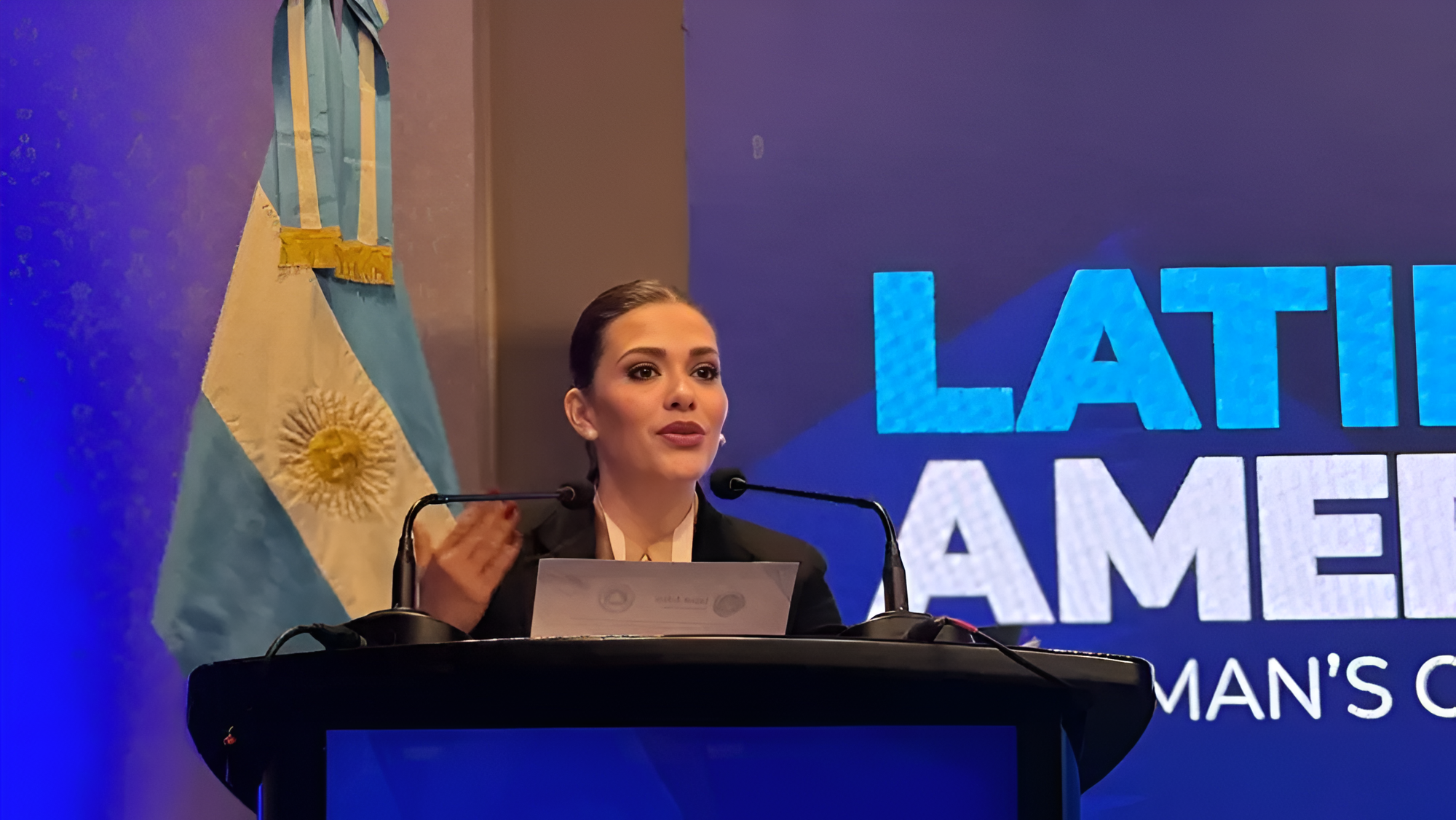
IMAGE: Karla Gutiérrez, president of the Central American Parliament (PARLACEN), at the Israel Allies Caucus launch on 11 August 2026. (Source: JNS)
Israel and Argentina launched the Isaac Accords in April, but Guatemala has not joined. PARLACEN, based in Guatemala City, brings together legislators from Guatemala, El Salvador, Honduras, Nicaragua, Panama and the Dominican Republic, and can confer observer status without the Guatemalan government signing the Accords. That gave Israel’s advocates a route to a regional foothold while Guatemala remained outside their formal membership.
The caucus and the vote
Gutiérrez was the only Guatemalan participant identified by name in available accounts of the Buenos Aires conference. She attended as PARLACEN president rather than as a representative of Guatemala’s national legislature, framing her support for Israel in terms of shared Judeo-Christian values. Reinstein gave that appeal a political purpose, saying observer status would show what happens when politicians turn biblical support for Israel into “concrete political action.” With a vote anticipated in October, the campaign would need to continue after the delegations left Buenos Aires.
American Friends of Isaac Accords brought the initiative into the meeting and had made the Israel Allies Foundation one of its first grant recipients. IAF brought its network of parliamentary caucuses and its model of “faith-based diplomacy,” while conference organisers said delegates committed to coordinated political action. Its Latin America director, Leopoldo Martínez, called the August group a permanent platform for cooperation with Israel between plenary sessions. The foundation says it works in 65 legislatures and described the new PARLACEN group as its 66th caucus, extending that model into the chamber where Gutiérrez was seeking votes for Israel.

IMAGE: Launch of the Parliamentary Group Allies of Israel at PARLACEN – Guatemala City, 11 August 2026. (Source: PARLACEN)
PARLACEN’s observer rules make observer status more than a symbolic gesture. It is governed by a specific incorporation agreement that sets the terms of participation, including representation, contributions and rights inside the parliament. PARLACEN showed the geopolitical value of that access in 2023, when it removed Taiwan and accepted China as a permanent observer. The caucus was therefore not simply an expression of support for Israel, as it gave the campaign a base inside a regional institution alongside Guatemala’s existing trade, technical and procurement ties with the country.
The relationships already in place
Guatemala’s free-trade agreement with Israel took effect in March 2024, creating a bilateral framework for cooperation in sectors including water management, irrigation and renewable energy, according to its official treaty profile. The agreement predates the Isaac Accords and does not determine how PARLACEN will vote. But it shows that the sectors now proposed for regional investment, water, agriculture and energy, already have a bilateral framework in Guatemala.
Israel’s development agency, MASHAV, also has an established presence in Guatemala. The Israeli embassy says its agricultural modernisation centre opened at the ENCA agricultural school in 2022, where Israeli experts have trained more than 1,500 farmers, extension workers and technicians in irrigation, water management and related fields. That work predates the Isaac Accords, but it has already put Israeli expertise and local institutions together in the agricultural and water sectors where future projects would be developed.
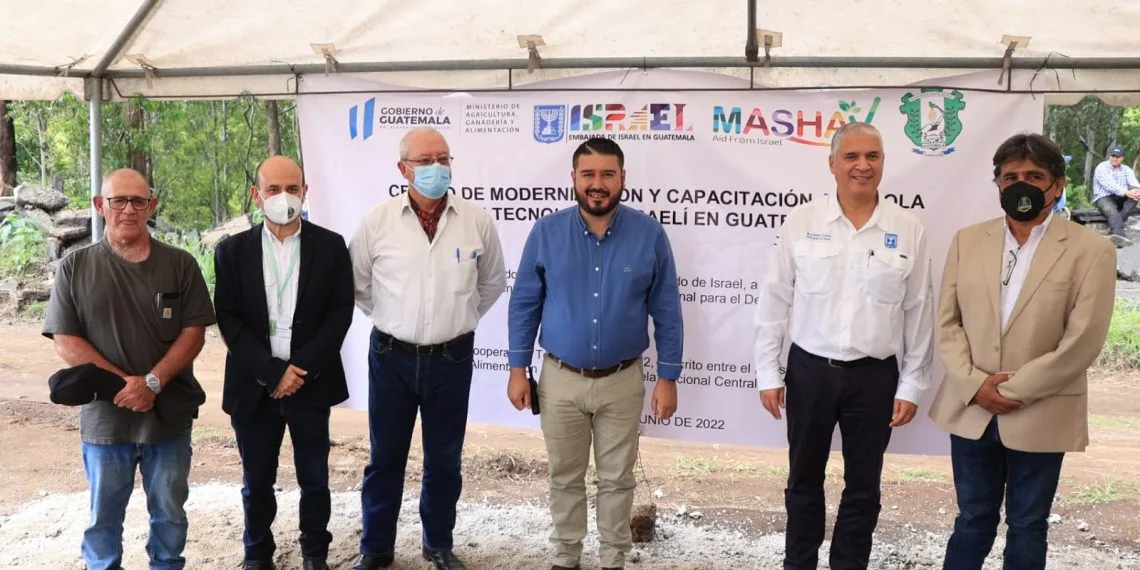
IMAGE: Israeli ambassador Mattanya Cohen joined Guatemalan officials to open the MASHAV-backed agricultural modernisation centre at ENCA on 22 June 2022. (Source: MAGA photograph via Agencia Guatemalteca de Noticias)
Sebastián Siero, president of Guatemala’s National Association of Municipalities, met Israeli ambassador Alon Lavi in July 2025 to discuss cooperation and strategic projects across the country’s 340 municipalities. The association reported no resulting contract, but the meeting placed Israeli officials in contact with the municipal leaders who decide which water systems and public works move forward.
Guatemala’s army has used another bilateral channel to buy from Israeli suppliers. Under a 2023 defence memorandum with Israel, it completed four direct purchases worth Q79.3 million in May 2024 from Elbit entities and Marom-Dolphin, according to eP Investiga’s reporting from Guatecompras records and implementation agreements. The purchases show how an existing bilateral framework can deliver contracts to Israeli suppliers. Guatemala had already bought Israeli surveillance tools, with consequences for privacy and public oversight.
Guatemala’s earlier purchases of Israeli surveillance tools put a harder edge on the proposed digital-technology agenda. A 2018 investigation reported more than Q90 million in public spending on surveillance systems that included Pegasus and Circles, while Citizen Lab later identified a Circles system apparently operated by Guatemala’s civilian intelligence agency, DIGICI. Guatemala’s record on Israeli surveillance tools is part of a broader pattern that also includes a corruption case involving an Israeli water technology.
In 2014, the state contracted M. Tarcic Engineering to supply a product for Lake Amatitlán, a deal CICIG described as a Q22.83 million purchase of 23,000 litres alongside a proposed Q115 million contract to apply it. The arrangement later became a corruption case, leaving a local precedent for the proposed investment facilities and raising questions about who sets the terms, tests the technology and scrutinises contracts before public money is committed.
The finance still out of view
Israel and the Inter-American Development Bank announced a letter of intent on 1 June 2026, before Gutiérrez took her observer-status campaign to Buenos Aires. The proposed facilities would combine Israeli expertise and capital with lower-cost financing for agriculture, water, energy and digital technologies, extending the Isaac Accords agenda from political organising into investment. No document obtained for this investigation shows that the PARLACEN caucus has directed an IDB-backed project to Guatemala.
Luz Itzá Cocom Apaza places those existing relationships alongside the new caucus and calls the political cover potentially supplied by bank-backed finance the “Triple-A Shield of Plunder”. Her warning is that a development bank’s standing can lend credibility to commercial expansion while states and communities carry the debt, environmental costs and loss of control over essential services. Those unanswered terms take on particular weight in Guatemala, where access to water remains deeply unequal.
Today, more than seven million Guatemalans lack an indoor water connection. Half of Indigenous Guatemalans live without running water at home, compared with one-third of non-Indigenous people. The IDB’s accountability mechanism has already investigated complaints linked to two hydroelectric projects in Guatemala and issued its review in Mayan Chuj and Q’anjob’al. The investigation left a record of what can happen when Indigenous communities enter the process only after a project has taken shape.
VIDEO: Guatemalans describe the struggle to access water. This Human Rights Watch film documents conditions that predate the proposed Isaac Accords investment facilities – 2 July 2025. (Source: Human Rights Watch)
.
If Isaac Accords-linked finance reaches water, energy or agriculture, the question is who decides before money is committed and contracts are set. Indigenous authorities and community water systems have too often entered after those terms are fixed. Israel’s advocates had already gained a caucus inside PARLACEN ahead of the observer-status vote Gutiérrez expected. The project pipeline remains undisclosed, but the political campaign has already gained a place inside PARLACEN without a public account of the very projects it may help advance.
READ MORE SOUTH AMERICA NEWS AT: 21st CENTURY WIRE SOUTH AMERICA FILES
SUPPORT OUR INDEPENDENT MEDIA PLATFORM – BECOME A MEMBER @21WIRE.TV
VISIT OUR TELEGRAM CHANNEL