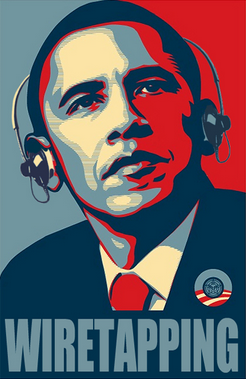



Proposed Wiretapping Legislation Bureau’s Top Priority

21st Century Wire says… Are we reading this right? Yes, the Obama regime has officially trumped the Bush Cabal – embracing the secret Stasi state enforcement mechanism… 

Ellen Nakashima
Washington Post

A government task force is preparing legislation that would pressure companies such as Face­book and Google to enable law enforcement officials to intercept online communications as they occur, according to current and former U.S. officials familiar with the effort.

Driven by FBI concerns that it is unable to tap the Internet communications of terrorists and other criminals, the task force’s proposal would penalize companies that failed to heed wiretap orders — court authorizations for the government to intercept suspects’ communications.

WiretappingRather than antagonizing companies whose cooperation they need, federal officials typically back off when a company is resistant, industry and former officials said. But law enforcement officials say the cloak drawn on suspects’ online activities — what the FBI calls the “going dark” problem — means that critical evidence can be missed.

“The importance to us is pretty clear,” Andrew Weissmann, the FBI’s general counsel, said last month at an American Bar Association discussion on legal challenges posed by new technologies. “We don’t have the ability to go to court and say, ‘We need a court order to effectuate the intercept.’ Other countries have that. Most people assume that’s what you’re getting when you go to a court.”

There is currently no way to wiretap some of these communications methods easily, and companies effectively have been able to avoid complying with court orders. While the companies argue that they have no means to facilitate the wiretap, the government, in turn, has no desire to enter into what could be a drawn-out contempt proceeding.

Under the draft proposal, a court could levy a series of escalating fines, starting at tens of thousands of dollars, on firms that fail to comply with wiretap orders, according to persons who spoke on the condition of anonymity to discuss internal deliberations. A company that does not comply with an order within a certain period would face an automatic judicial inquiry, which could lead to fines. After 90 days, fines that remain unpaid would double daily.

Instead of setting rules that dictate how the wiretap capability must be built, the proposal would let companies develop the solutions as long as those solutions yielded the needed data. That flexibility was seen as inevitable by those crafting the proposal, given the range of technology companies that might receive wiretap orders. Smaller companies would be exempt from the fines.

The proposal, however, is likely to encounter resistance, said industry officials and privacy advocates.

“This proposal is a non-starter that would drive innovators overseas and cost American jobs,” said Greg Nojeim, a senior counsel at the Center for Democracy and Technology, which focuses on issues of privacy and security. “They might as well call it the Cyber Insecurity and Anti-Employment Act.”

The Obama administration has not yet signed off on the proposal. Justice Department, FBI and White House officials declined to comment. Still, Weissmann said at the ABA discussion that the issue is the bureau’s top legislative priority this year, but he declined to provide details about the proposal.

Read more at Washington Post

facebooktwittergoogle_plusredditpinterest

John Whitehead Interviews Brandon Raub

Brandon Raub, a decorated US Marine who was arrested by federal agents and incarcerated in a psych ward for  posting ‘anti-government thoughts’ and song lyrics to his Facebook page, discusses the incident with John Whitehead, Constitutional Attorney and President of The Rutherford Institute
facebooktwittergoogle_plusredditpinterest

Federal Intelligence Ruling Fails to Lift Veil on Obama’s Domestic Spying Program

.

“Is this a gateway that is thrown wide open to any level of spying on Americans, or is it not?”
.

Ellen Nakashima
Washington Post
January 20, 2013

Three years ago, U.S. officials launched a review of significant classified rulings by a federal intelligence court to see which could be redacted sufficiently for public release. To date, none have.

The Lives of Others: Washington is now officially in the same league as the Stasi in East Germany.

The challenge, said Robert S. Litt, general counsel at the Office of the Director of National Intelligence, is that “in many cases, classified information is so intertwined with the legal analysis that removing the classified information would leave a document that lacks any meaningful substance.”

Some lawmakers have pressed the government for years to declassify significant opinions by the Foreign Intelligence Surveillance Court, arguing that the public has a right to know how the secretive court is interpreting laws that affect Americans’ privacy.

“We have been attempting to prepare redacted opinions and are hopeful we can reach a point where it might be possible to release them in a manner that protects national security,” Litt said in an e-mail exchange last week.

The Foreign Intelligence Surveillance Act, amended several times since the September 2001 terrorist attacks, authorizes the gathering of foreign intelligence on U.S. soil in a myriad of ways — including monitoring phone calls and e-mail — with restrictions to protect Americans’ privacy.

The FISA court determines whether the government’s intelligence-gathering tactics are legal under the surveillance act. It also evaluates the efforts to protect the privacy of U.S. citizens.

The court consists of a federal judge who hears government requests to conduct surveillance. Appeals are heard by a panel of judges called the FISA Court of Review.

Steven Aftergood, a secrecy expert at the Federation of American Scientists, has argued that the government can share some of the court’s decisions by removing operational details. He says that approach would enable the government to provide summaries of cases that would define the types of activities, without jeopardizing national security. He noted that the government has declassified and released several FISA court decisions in the past.

When FISA provisions came up for reauthorization in the Senate last month, Sen. Jeff Merkley (D-Ore.) raised concerns that court rulings allow the FBI to obtain records and other information about Americans caught up unwittingly in a foreign terrorism investigation.

“Is this a gateway that is thrown wide open to any level of spying on Americans, or is it not?” he asked.

His amendment to require that the government declassify or summarize significant court opinions failed. But Sen. Dianne Feinstein (D-Calif.), the Senate Intelligence Committee chairman, said she supports his effort, and aides said a letter is being drafted to government officials.

facebooktwittergoogle_plusredditpinterest

RUMOURS OF BACKLASH AGAINST BLOGGERS: Details surface after Slog asked to delete links

The Slog Dec 11, 2012 Having been tipped off last week about the pulling together of a Government plan to attack bloggers via McAlpinesque legal threats, The Slog received in short order a series of requests from a variety of blogospherists, asking for links to articles about leading politicians to be deleted. Jeremy Hunt and Boris Johnson were the anti-free speech fanatics most often cited. Now more details of a new Bill to complement that strategy are starting to surface. It isn’t looking pretty. Useless legislator and empty suit Nick Clegg may be about to pull off the one achievement of his risible Deputy Premiership: new powers to monitor email and internet use need a “fundamental rethink”, he says. And he “vowed” (always beware the vow) to block the draft Communications Data Bill, instead pushing alternative plans that would reduce liberty infringement to a minimum. His comments came as a committee of MPs and peers criticised the bill’s scope, with several voices on all sides at Westminster increasingly prepared to view the Leveson Report as a Trojan Horse crammed with new laws to stifle online debate, revelation and speculation. Leveson himself was notably quick to cite the Aussie DJ phone-call prank as another example of the need for tougher privacy laws….an interesting comment given that it has nothing whatever to do with the internet or the press media. (See a new Slogpost asking valid question about this case) Justice Leveson blew all his credibility when he released the ‘finding’ that Jeremy Hunt had acted fairly and without bias in the BSkyB takeover saga. If he acted fairly at all, then it was a mode he was forced into as post-Dowler public pressure grew for the entire Murdoch clan to be put down. The takeover of BSkyB was thus abandoned. There remain at least four question-marks over Hunt’s behaviour before and during this time: none of them have been satisfactorily answered or investigated. And lest we forget, Hunt himself was involved in the choice of Leveson: his signature is on the appointment confirmation. So while Clegg’s hour may have come, we can all assume that his interest in this issue is purely opportunistic. The broader policy (which I am sure he privately supports) will be to put the legal frighteners on anyone telling the truth about contemporary issues, while using GCHQ as a means of reminding site owners that Big Brother is watching. Already, it seems clear to me the strategy is working. We need to stop and think here about the sheer variety and volume of bogus news being fed to the MSM at the moment. The Syrian conflict, the EU-UK negotiation standoff, the move towards an EU referendum, the emphasis on McAlpine’s heart bypass rather than systemic paedophile abuse, the hijacking of the Rotherham scandal by pointless UKip speculation, endless NHS spin hiding a reality of preparing for privatisation….there is a lot at stake for those who wish to hide rather than share. But I wouldn’t hold your breath looking for support from the MSM: this sort of stuff will suit everyone from the Guardian via the Mail and the Mirror to the Telegraph and the Times: none of the Rusbridger-Trinity-Dacre-Barclay-Murdoch axis want to sustain a vibrant internet. For one thing, it doesn’t follow their agenda of complicity; for another, we’re putting them out of business… (…) I confess to being at the stage with Fellows where I suspect he’s living in a film script written by his namesake, but on the other hand there’s a reasonable chance he’s being fed this stuff with a view to delivering more scare-tactics into an already hyperventilating blog community… Read the full Slog here  facebooktwittergoogle_plusredditpinterest