

‘Pax Romana’? Looking Back at a Terrible Error in Modern U.S. History

21st Century Wire says… Many a retrospective has been written on the 10th Anniversary of the Iraq invasion by the US and its ‘coalition forces’, and the article below is just one aspect worth discussing. Either way you cut, any action based solely on a lie, cannot end well for either side. Like Rome, the Anglo-American Empire’s activities in far-off lands has led to the implosion of its society back home…

David Ignatious

Daily Star

Ten years ago this week, I was covering the U.S. military as it began its assault on Iraq. As I read back over my clips, I see a few sensible warnings about the difficulties ahead. But I owe readers an apology for being wrong on the overriding question of whether the war made sense.

Invading Iraq to topple Saddam Hussein a decade ago was one of the biggest strategic errors in modern American history. We’ll never know whether the story might have been different if better planning had been done for “the day after,” or the Iraqi army hadn’t been disbanded, or several other “ifs.” But the abiding truth is that America shouldn’t have rolled the dice this way on a war of choice.

As I think back to the crucible of 2003, two remarks made by Arab friends stand out particularly. One was from a prominent Lebanese Shiite publisher who supported the war, but on the condition that America was resolute enough to finish what it was starting. “If Rome is strong, the provinces are ready,” my friend said.

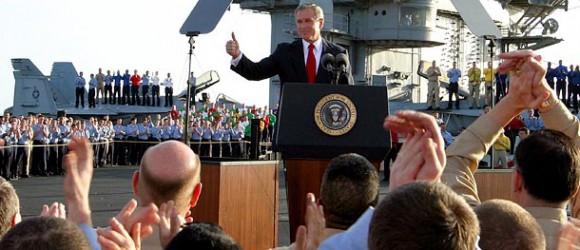
But Rome wasn’t strong enough to prevail. America’s military power, awesome as it was, turned out not to be sufficient to impose a settlement in Iraq; and in a grinding war of occupation, all America’s might could not turn on the electricity in Baghdad or frighten Sunnis and Shiites into cooperating with each other. Rome was also weak at home, politically: The U.S. didn’t have the stomach for a protracted war that President George W. Bush couldn’t explain and the public didn’t understand.

The second comment was from a Syrian friend who opposed the war. In 2002, when we first discussed the coming battle, he was reading “The March of Folly,” historian Barbara Tuchman’s account of epochal policy blunders through history. America was about to make another mistake of historic dimensions, my friend warned.

This person took me aside after the fighting had been raging for several months. I am still haunted by what he said: “I am sorry for America. You are stuck. You have become a country of the Middle East. America will never change Iraq, but Iraq will change America.”

What other lessons should America learn from Iraq? An obvious one is the danger of creating a political vacuum by overthrowing a dictator. The U.S. dreamed that it would modernize Iraq by toppling Saddam Hussein. But when it disbanded the nonsectarian army and most of the secular government, Iraqis had nowhere to turn but their most basic ethnic and tribal identities as Sunnis or Shiites, Kurds or Arabs.

Many in the CIA understood the need to keep the Iraqi army and civil service together. That’s part of why they clashed so sharply with Donald Rumsfeld’s Pentagon and his Iraqi champion, Ahmad Chalabi, who wanted to dismantle the Baath Party, root and branch. I watched a tiny part of that battle play out one day in April 2003 in a bitter argument on the lawn of Chalabi’s headquarters at the Mansour Hunting Club in suburban Baghdad. The headline on that one was “Bush’s confusion, Baghdad’s mess.”

In the political vacuum the U.S. created, Iraq tumbled into the past – pulling a lot of the Arab world with it. That’s part of why President Barack Obama has been so careful recently in dealing with Syria: He doesn’t want America to make the same mistake twice. But history is cruel: You can try so hard to avoid an outcome that in your very passivity, you make it more likely.

Another lesson is the importance of dignity in the Arab world. Most Iraqis despised Saddam Hussein because, in addition to torturing their sons and daughters, he had taken their dignity. But many came to loath America as well, because for all our talk of democracy, Americans damaged their sense of honor and independence. As the Arab world proves over and over, from Palestine to Benghazi, people who are penniless in terms of material possessions would rather die than lose their sense of honor to outsiders.

A final lesson is the benefit of persistence. Bush made a disastrous mistake invading Iraq in 2003. But having busted up the country, he tried his best to clean up the mess. By checking the spiraling sectarian killing, the surge of U.S. troops led by Bush and Gen. David Petraeus saved thousands of Iraqi lives. It’s one thing that Americans did right in this painful story.

David Ignatius is published twice weekly by THE DAILY STAR.

facebooktwittergoogle_plusredditpinterest

CRF Mafia’s IAEA Provide Latest WMD Talking Point for Washington and Tel Aviv Hawks

U.N. nuclear chief: ‘Alleged weapons testing site was probably sanitized by Iran’…

21st Century Wire says: Yet, in the same breath, the UN and CFR puppet admits, “We cannot say for sure that we would be able find something” By Joby Warrick December 7, 2012 The United Nations’ chief nuclear official urged Iran on Thursday to allow inspection of a military base where Iranian scientists are suspected of conducting secret nuclear-weapons research, although he acknowledged that any traces of illicit activity have probably been removed.

The war propaganda never stops: they are dedicating to lying their way into war.

International Atomic Energy Agency Director General Yukiya Amano said the nuclear watchdog would try again next week to visit the Parchin military base, a sprawling complex where Iran is thought to have conducted tests on high-precision explosives used to detonate a nuclear bomb. Iran has repeatedly refused to let IAEA inspectors visit the base, on the outskirts of Tehran. Instead, in the months since the agency requested access, satellite photos have revealed what appears to be extensive cleanup work around the building where tests are alleged to have occurred. “We are concerned that our capacity to verify would have been severely undermined,” Amano told a gathering of the Council on Foreign Relations in Washington. He noted Iran’s “extensive” cleanup effort at the site, which has included demolishing buildings and stripping away topsoil. “We cannot say for sure that we would be able find something,” Amano said. Read more at Washington Post (TRANSLATED IN ENGLISH: ‘A LOAD RECYCLED BULL S**T’)facebooktwittergoogle_plusredditpinterest

Laptop ‘destroyed to hide story’ about illegally obtained Saddam Hussein underpants image

More Leveson positioning… questions now raised over picture of former dictator published by Murdoch’s Sun and New York Post

By Dan Sabbagh and Lisa O’Carroll A Labour MP has told parliament he believes that a laptop was destroyed to eliminate evidence that a photograph of Saddam Hussein pictured in his underpants was obtained illegally – a picture of the former dictator that was published by the Sun and the New York Post on the front page of both Rupert Murdoch-owned newspapers in 2005. http://static.guim.co.uk/sys-images/Guardian/Pix/pictures/2012/12/3/1354572648813/Saddam-Hussein--010.jpgChris Bryant, speaking under the cover of parliamentary privilege in a debate on the Leveson report, said it was “difficult to see” how the editors of both newspapers and the reporters involved “could possibly pretend that they did not know” how the photograph was obtained “and that there had been criminality involved in the process of securing that photo”. He added “for that matter” it was difficult to see how the editors could say that “they didn’t know that the laptop on which that information and that photograph was kept was destroyed, I believe so as to destroy the evidence of that criminality”. The MP said he had information from “two well-placed people inside News International” that the newspapers paid “a substantial sum to a serving member of the United States armed forces in the United States of America for a photograph of Saddam Hussein”. He added that “a much larger amount was then paid via a specially set up account in the United Kingdom” to the same source. The picture of Saddam wearing only Y-fronts – whose ultimate source was alleged to be the US military – was run on the front pages of both newspapers in May 2005. The Sun headlined the image: “The tyrant’s in his pants.” Meanwhile, the Post, crediting the Sun, opted for “Butcher of Sagdad”. The MP did not name the editors of the newspapers. Rebekah Brooks was the editor of the Sun at the time, while Col Allan was then, and still is, the editor in chief of the New York Post. Bryant asked for News Corporation’s powerful management and standards committee, which has investigated alleged corrupt payments to public officials, to “provide all the emails from Rupert Murdoch to News International staff as a matter of urgency that relate to this matter and, in particular, to the photo of Saddam Hussein”. New Corp declined to comment on Bryant’s allegations other than to say that he was wrong about the management and standards committee, which the company said was continuing to co-operate with police. Payments to public officials are illegal in the US and the UK, and 21 journalists at the Sun have been arrested as part of the long-running Operation Elveden investigation into corrupt payments in Britain. The US Foreign Corrupt Practices Act bans US-owned companies from bribing public officials,.. Read more at The Guardianfacebooktwittergoogle_plusredditpinterest